
Bolzano Base Camp: Via Ferrata Adventures in Autumn, Winter and Spring
Six via ferrata routes around Bolzano during a February adventure with C., revealing the extraordinary variety of ferrata routes that make this area a truly unique base camp for year-round adventures.
Bolzano is, in many ways, the perfect base camp for via ferrata adventures. Nestled at the gateway to the Dolomites and surrounded by a remarkable variety of limestone mountains, the city offers access to an extraordinary number of ferrata routes within a surprisingly short distance.
During the summer season, when the snow has melted and the mountain huts reopen, Bolzano becomes an excellent starting point for classic Dolomites hut-to-hut via ferrata safaris, as well as hotel-based adventures exploring some of the most famous routes of the region.
But what truly makes this area special is that it happens also outside the main summer season!
In autumn, winter and spring, when many of the higher Dolomite routes are already covered in snow, the mountains around Bolzano still offer an incredible variety of climbable ferrata. Within less than an hour’s drive you can reach dozens of routes of different styles, difficulties and exposures: spectacular climbs overlooking Lake Garda, the many ferratas of the Paganella area, the limestone walls of Valle del Sarca and Rovereto, or the quieter and wild mountains of Val Venosta and Val Passiria.
The variety is simply astonishing. No other places in the Alps… probably in the world… offer such a concentration of via ferrata possibilities across so many seasons!
And perhaps the most beautiful part is the atmosphere. During these months the mountains are often quiet and peaceful. Ferratas that can be crowded in summer become almost empty, allowing you to climb surrounded by silence, listening only to the sounds of nature, while higher up in the Dolomites the snow already opens the door to winter ski adventures.
Six via ferrata routes in six days around Bolzano during a February adventure
Last week we spent six days exploring some of these routes together, for a February via ferrata safari based in Bolzano. While winter still dominates the higher Dolomites, the lower mountains surrounding the city offer a remarkable selection of ferrata routes that remain perfectly climbable during this time of year.
Over the course of the week we climbed six different via ferrata, each with its own character and atmosphere. Some routes followed steep walls high above the valleys, others traversed narrow gullies and dramatic rock formations, always surrounded by the quiet beauty of the winter landscape.
Every day brought a new destination and a different perspective on these mountains, sometimes climbing in the sun, sometimes in the cool shade of narrow valleys, but always enjoying the incredible variety that makes the area around Bolzano so unique.
Here is how the week unfolded.
Day 1 – Via Ferrata Burrone Giovanelli
The first day of the week was all about getting to know each other.
Whenever I start a multi-day adventure with a new guest, I like to begin with a route that allows us to move comfortably together while I can better understand their experience, strengths, ambitions and how they feel on exposed terrain. And introduce them to the use of the via ferrata set, with some tips to make climbing life easier!
For this reason I chose the Via Ferrata Burrone Giovanelli, located just about 40 minutes from Bolzano, near the village of Mezzocorona.
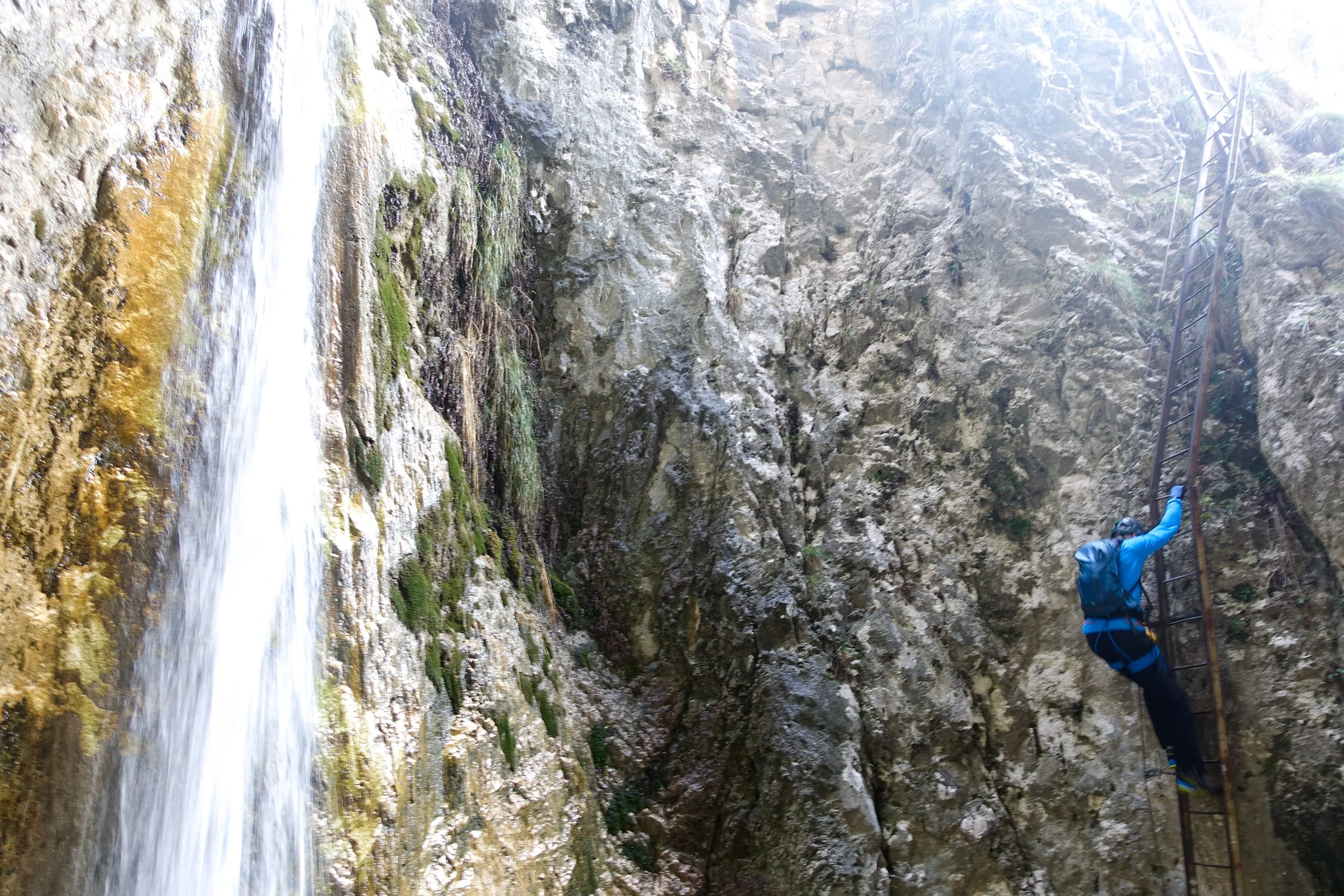
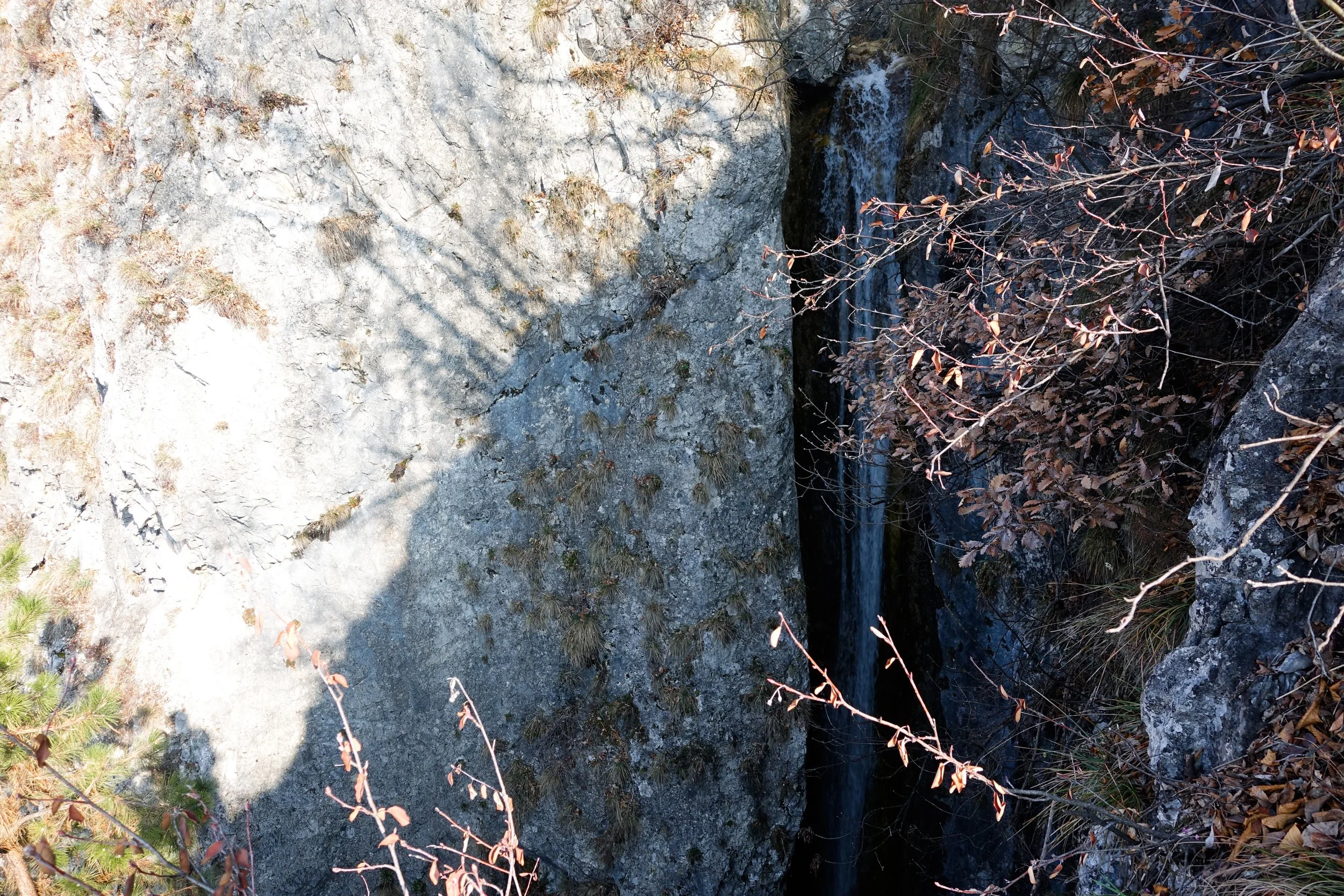
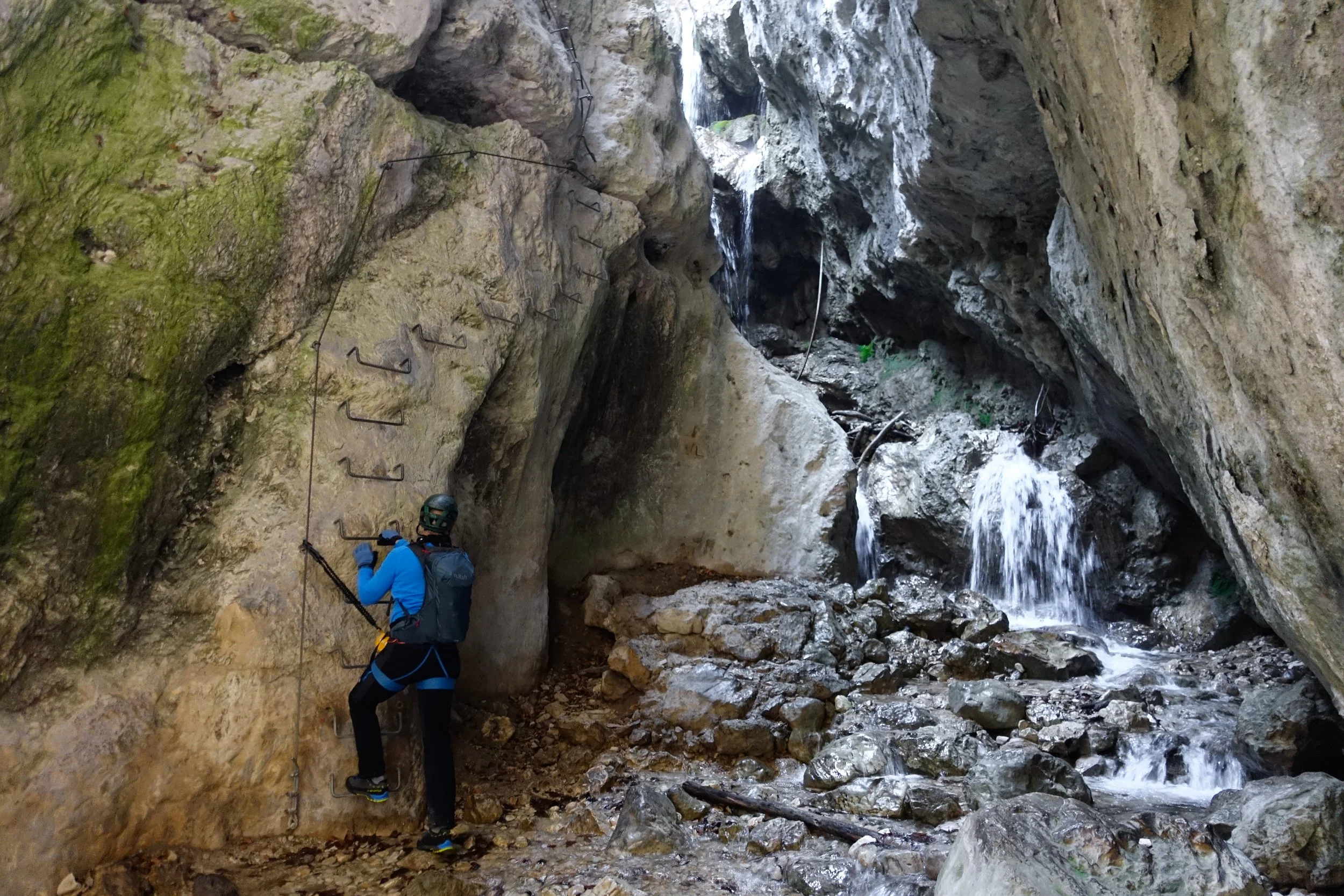
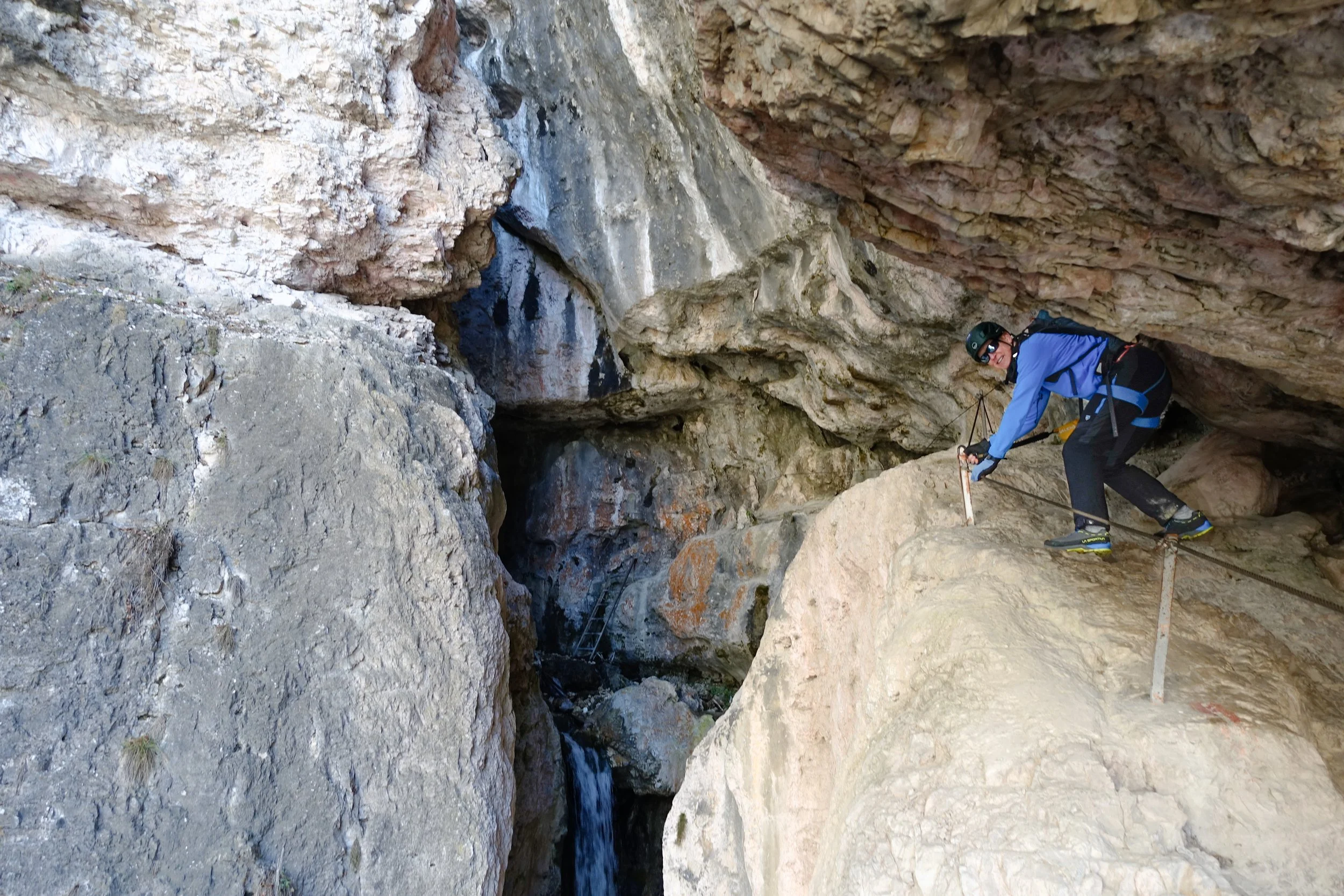
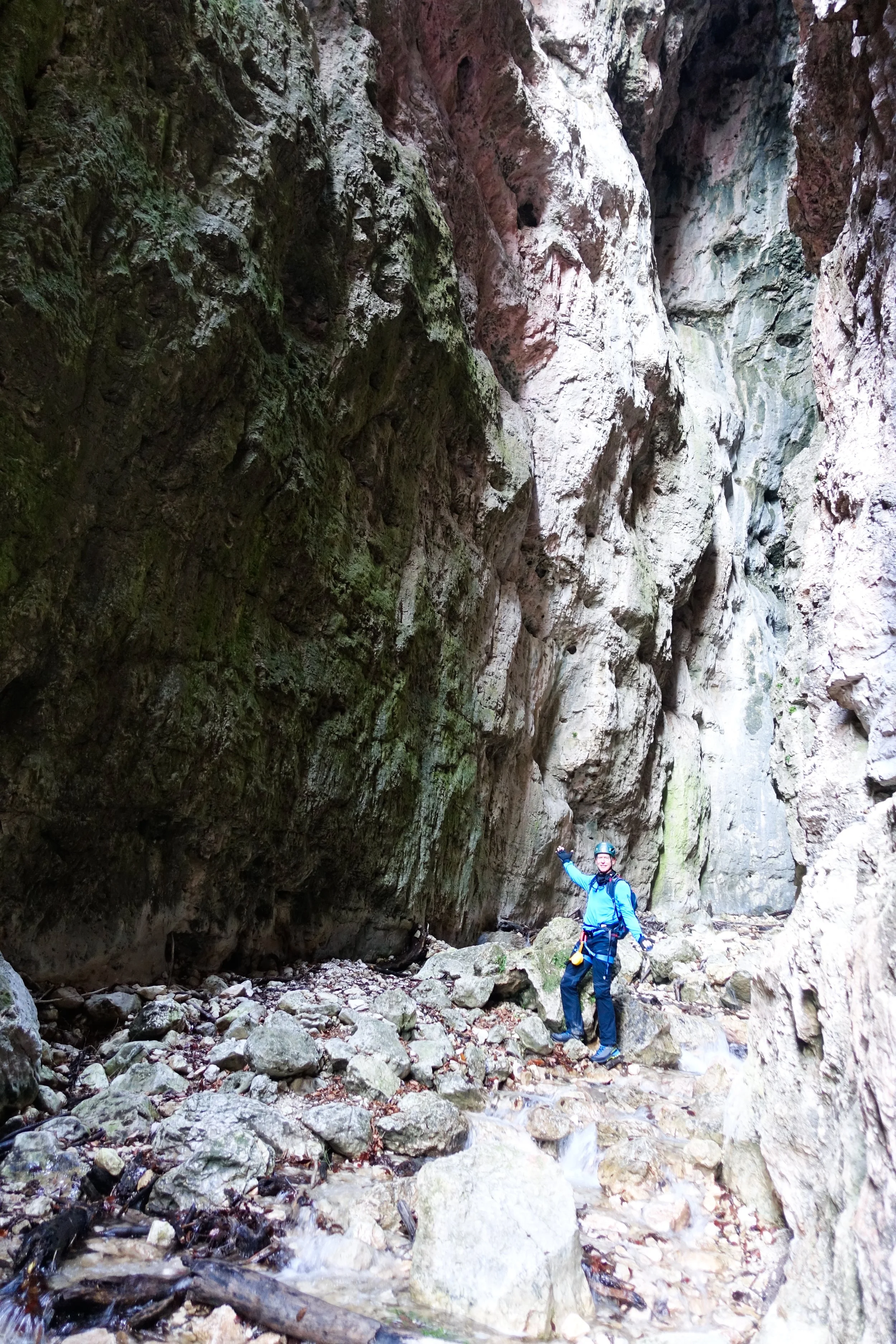
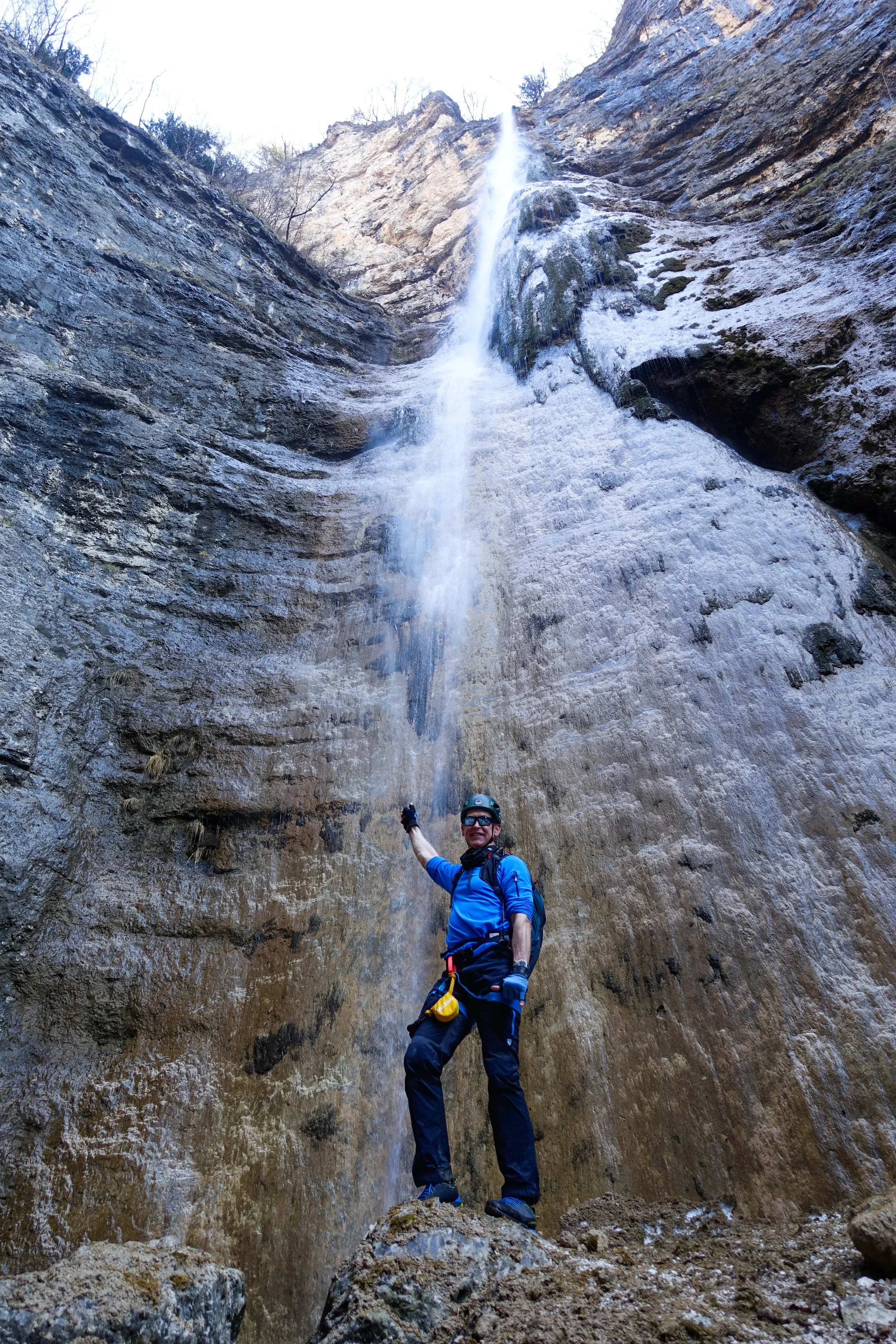
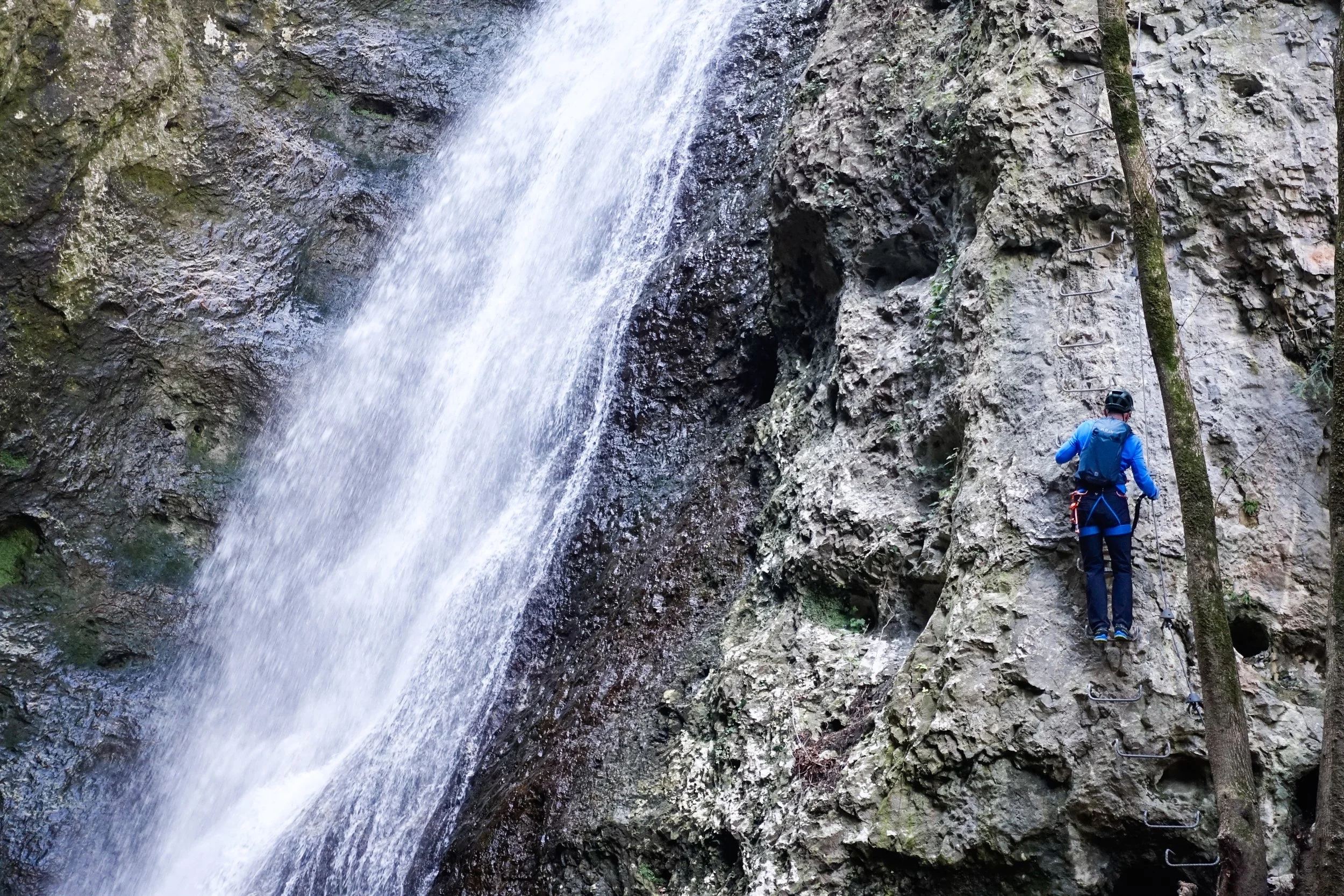
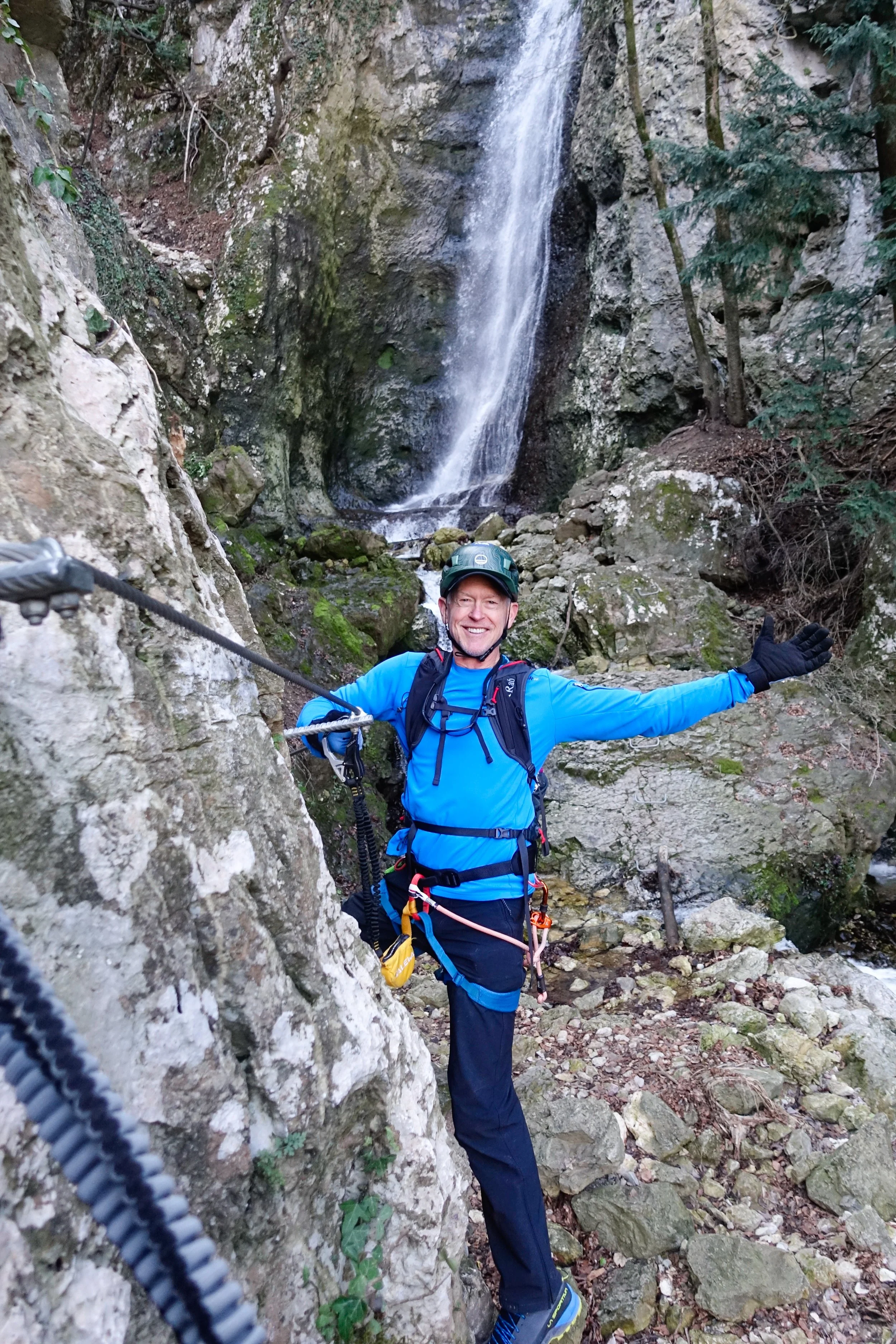
Technically the route is quite easy, but the environment is absolutely spectacular. The ferrata follows a narrow canyon with towering rock walls that rise high above you, opening and closing as you progress upward through the gorge. Along the way several waterfalls cascade down the rock, creating an atmosphere that feels almost hidden and wild, a bit Jurassic park! :D The climb begins immediately beside one of these waterfalls, ascending the first metal ladders right next to the rushing water… an unexpected and memorable way to start the adventure!
Although the technical difficulty is minimal, the route is a perfect introduction to via ferrata climbing, rewarding the effort with an incredibly scenic natural setting.
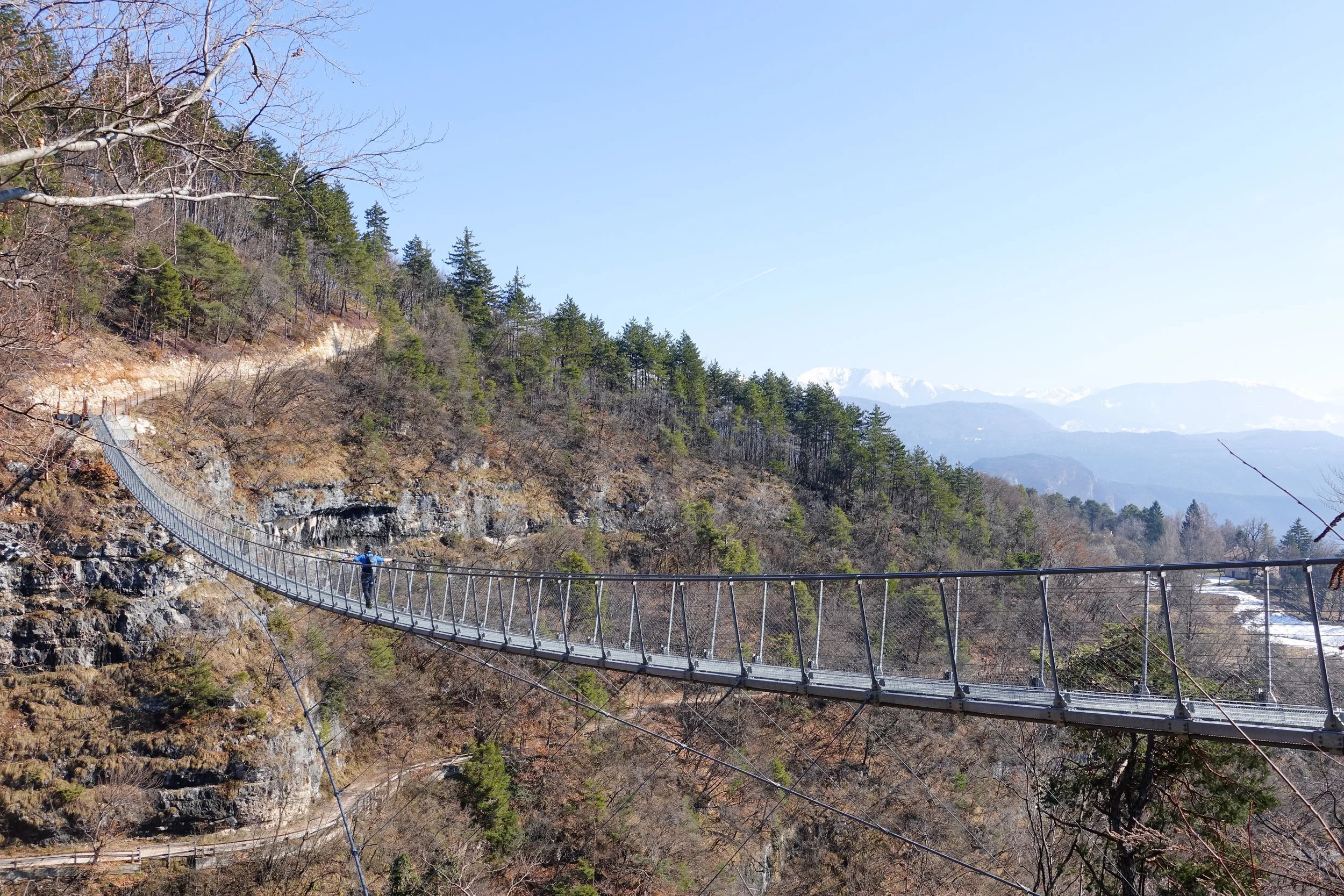
The day follows a beautiful loop hike with around 700 meters of elevation gain (about 2,300 ft). After climbing through the canyon, the trail reaches the forests above Monte di Mezzocorona, a lush area filled with pine trees and rich vegetation. From there we crossed a recently built suspension bridge spanning another impressive gorge, surrounded by vertical cliffs.
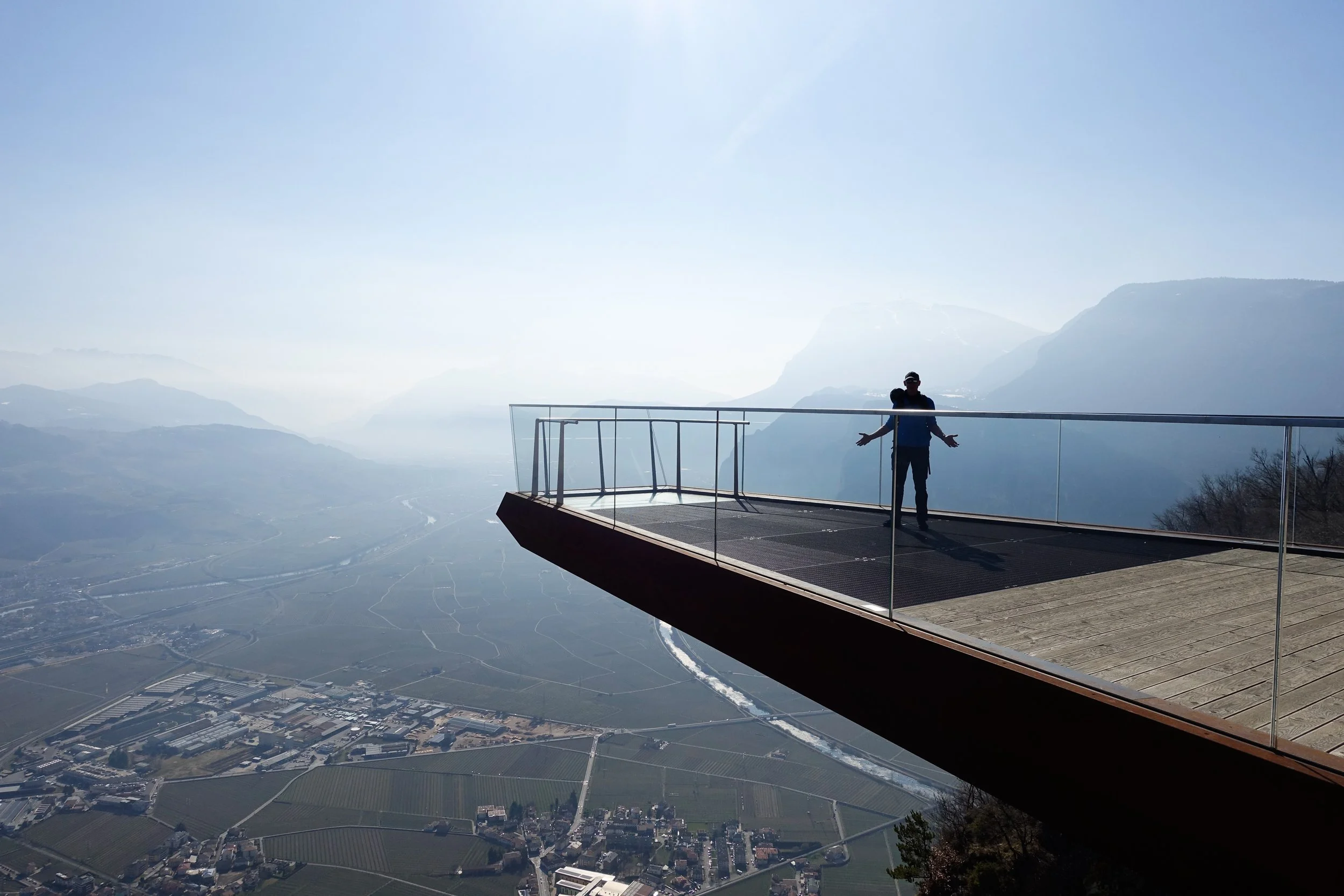
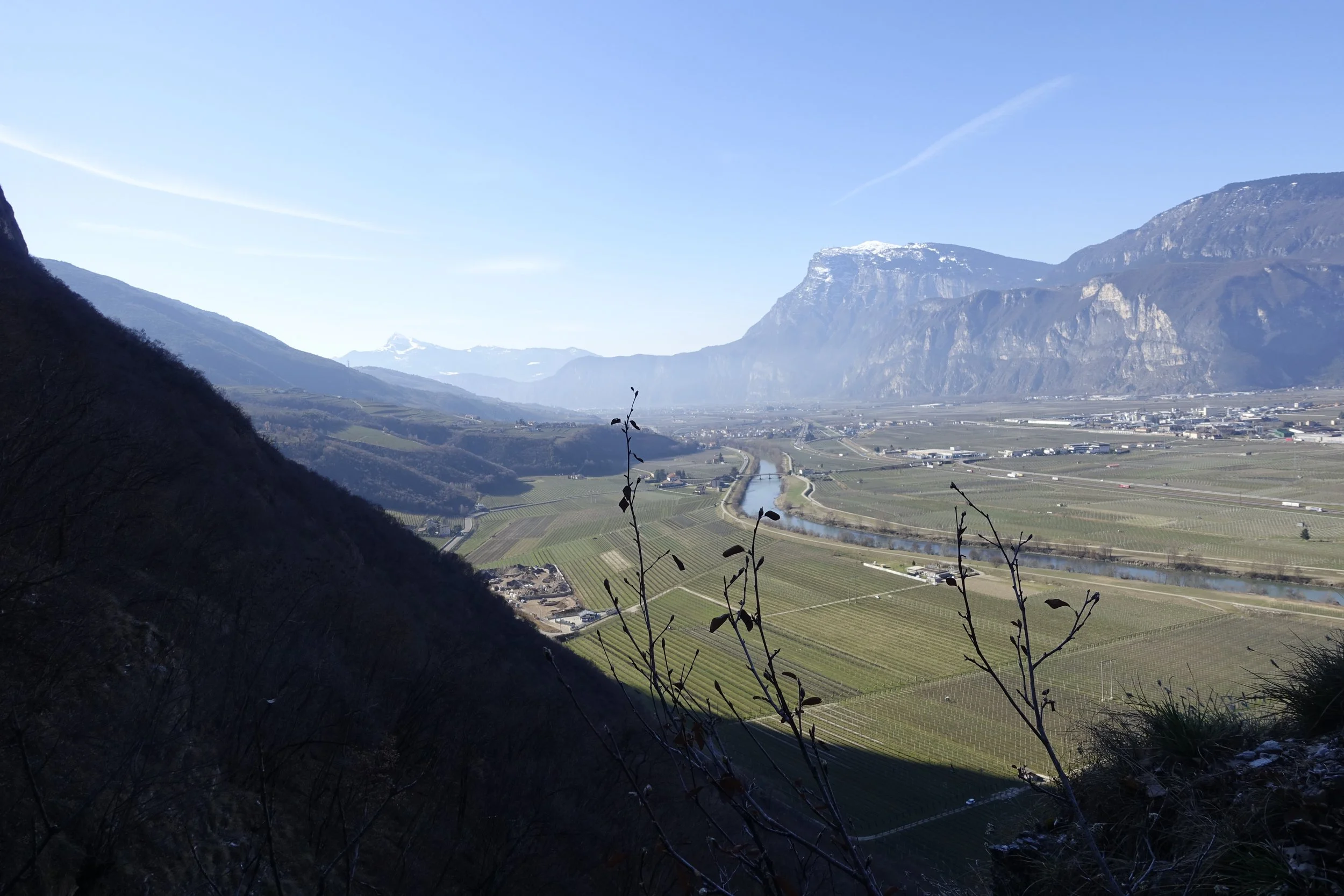
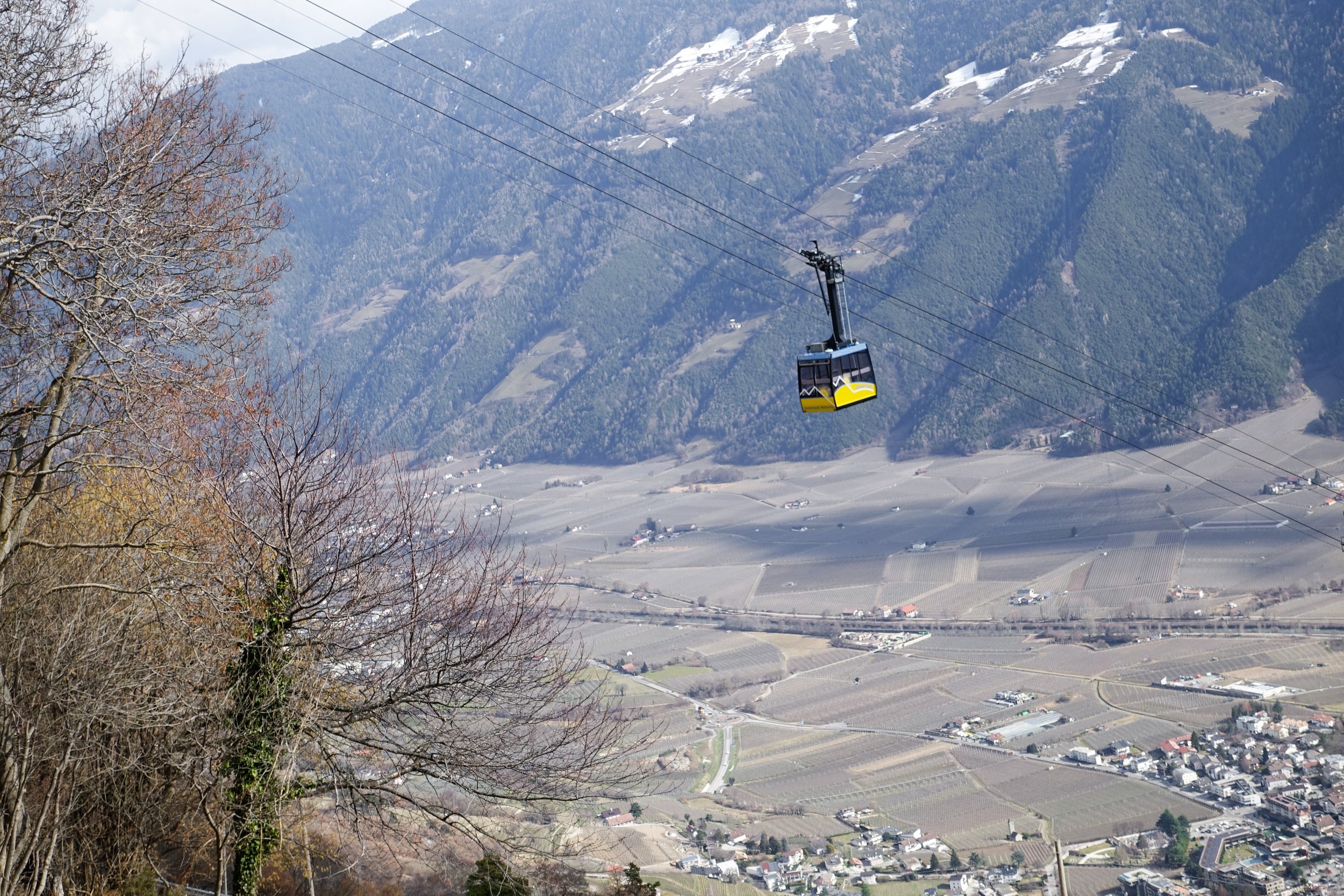
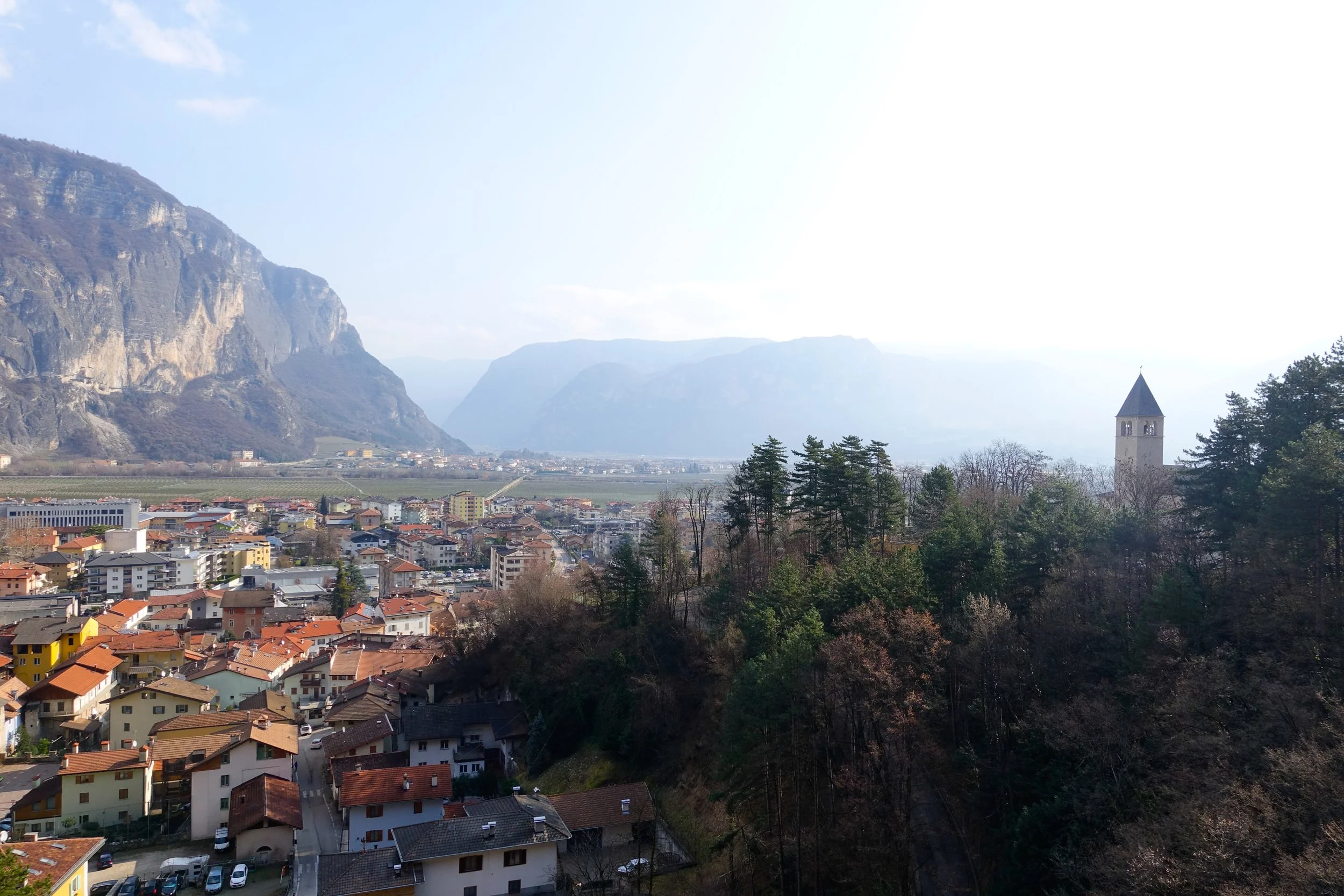
Eventually we reached the Monte di Mezzocorona plateau, near the cable car station, where we took a moment to visit the panoramic platform that extends dramatically out above the valley. Standing there, looking down over the vast vineyards of the Rotaliana plain, with many tower bells of the churces, ancient castles… and the Brenta Dolomites in the background is quite an experience!
To finish the day (and to save our knees for the rest of the week) we descended back to the valley by cable car.
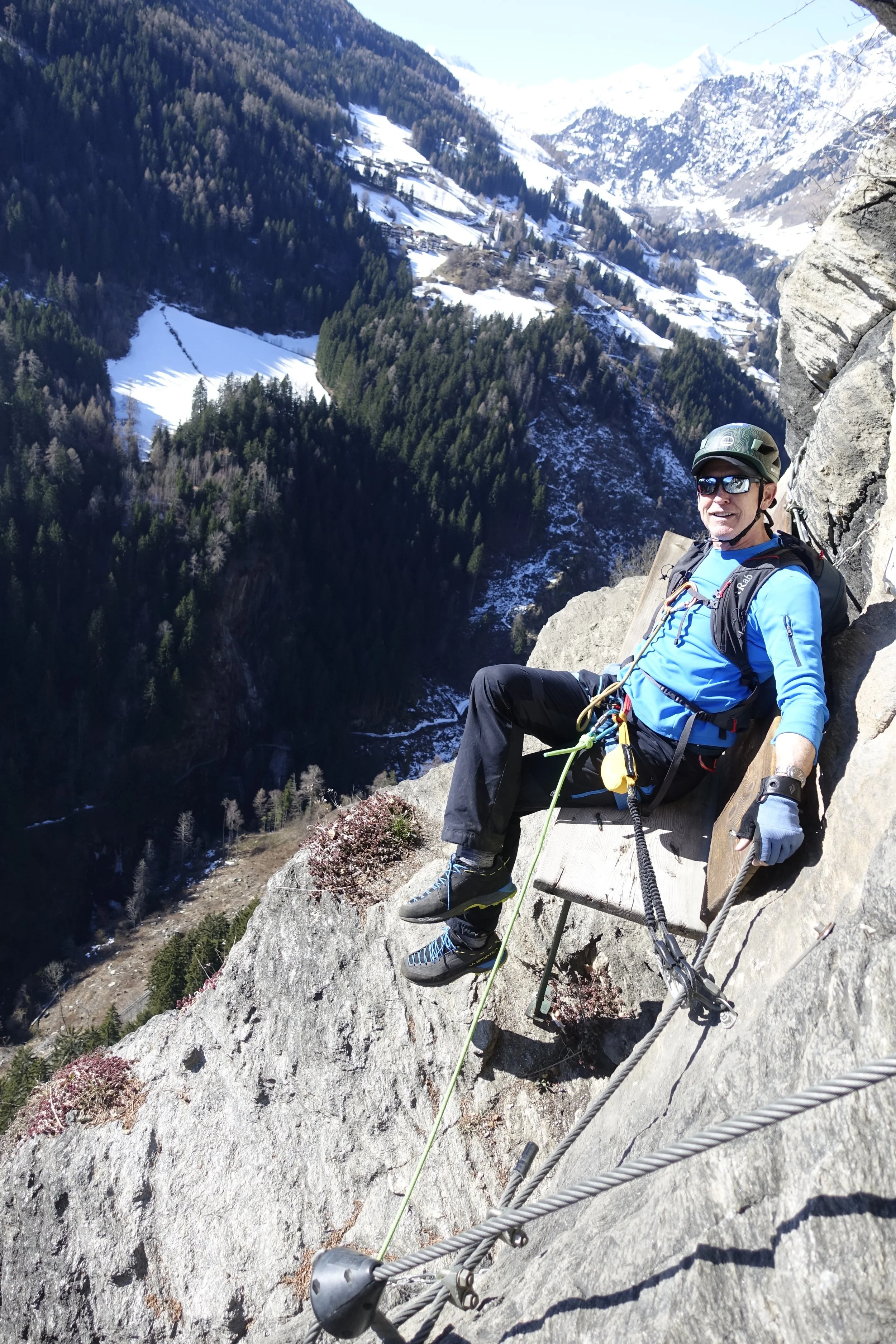
By the end of the day I had already learned a lot about my new friend. He was comfortable with exposure and moved confidently on the ferrata, showing good fitness and a calm mindset on the rock. Apart from a slight hesitation on the artificial platform :D …it was clear he was ready for more challenging adventures in the days ahead!
Day 2 – Via Ferrata Rio Secco
On the second day we decided to raise the technical level a little.
We started the morning at a relaxed pace, waiting for the temperatures to rise before heading out. Our objective for the day was Via Ferrata Rio Secco, located about 35 minutes from Bolzano.
True to its name, the canyon was completely dry when we arrived.
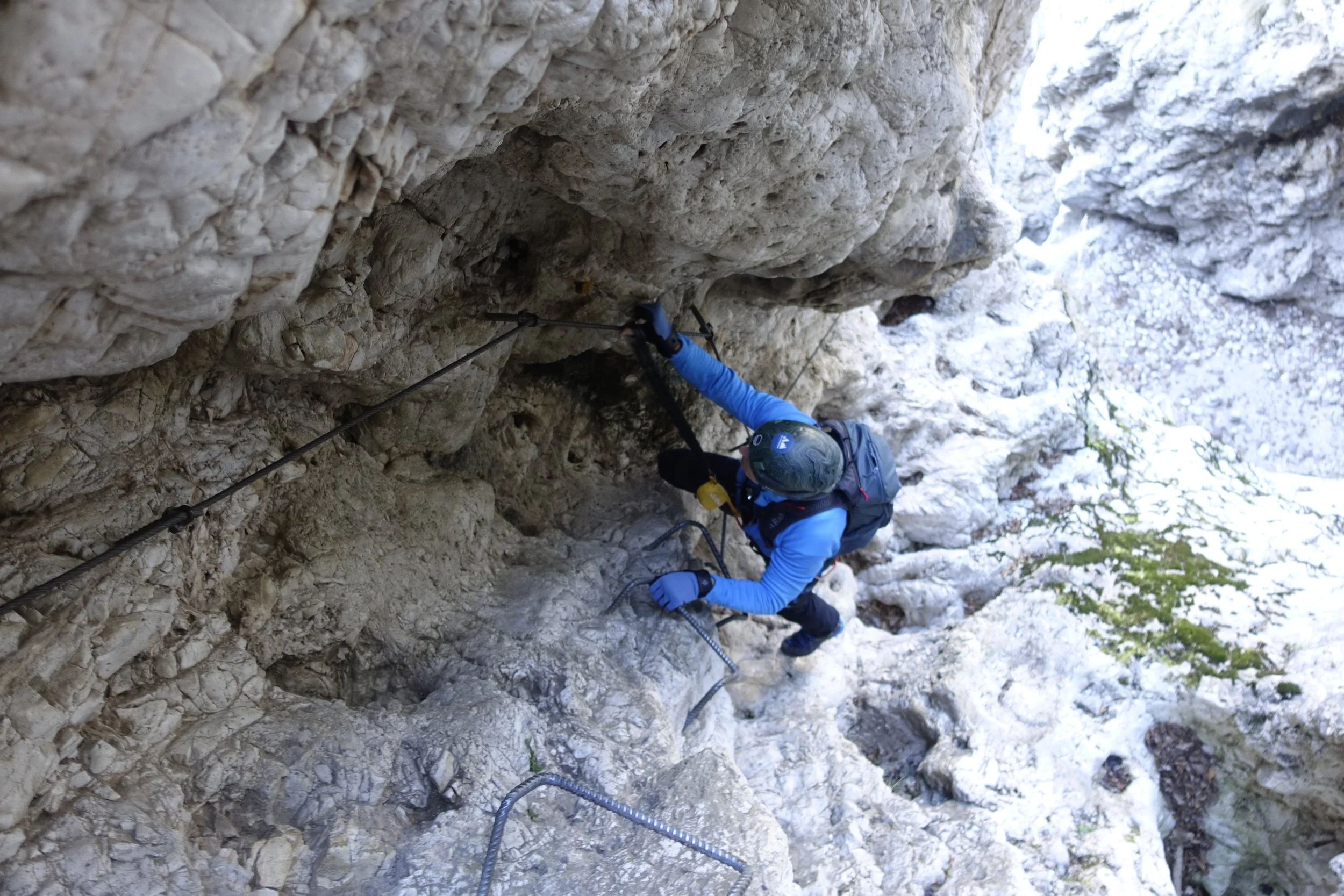
The approach is short — about 15 minutes — before reaching the start of the ferrata. The route is graded B with a few sections reaching C, making it a clear step up from the previous day.
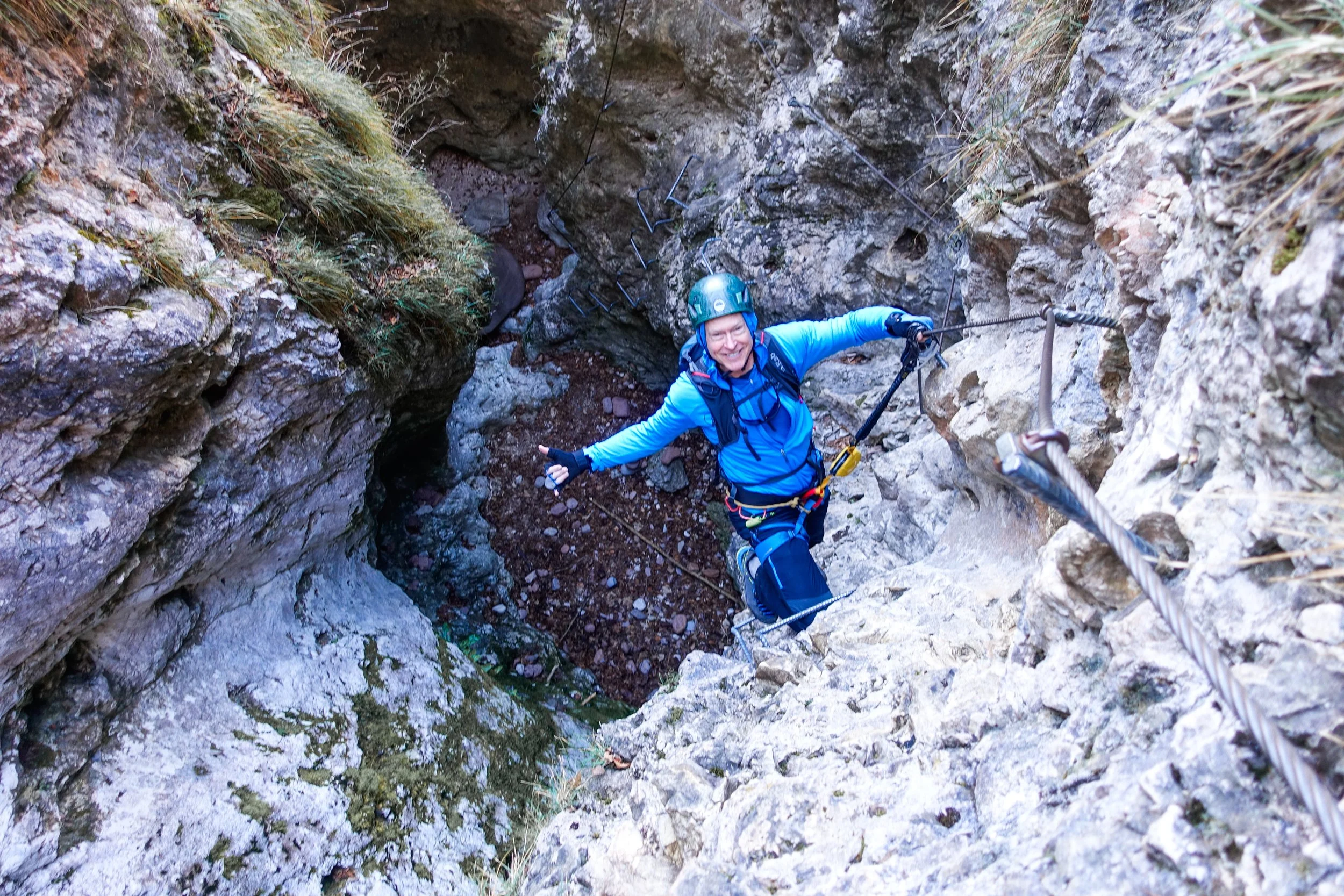
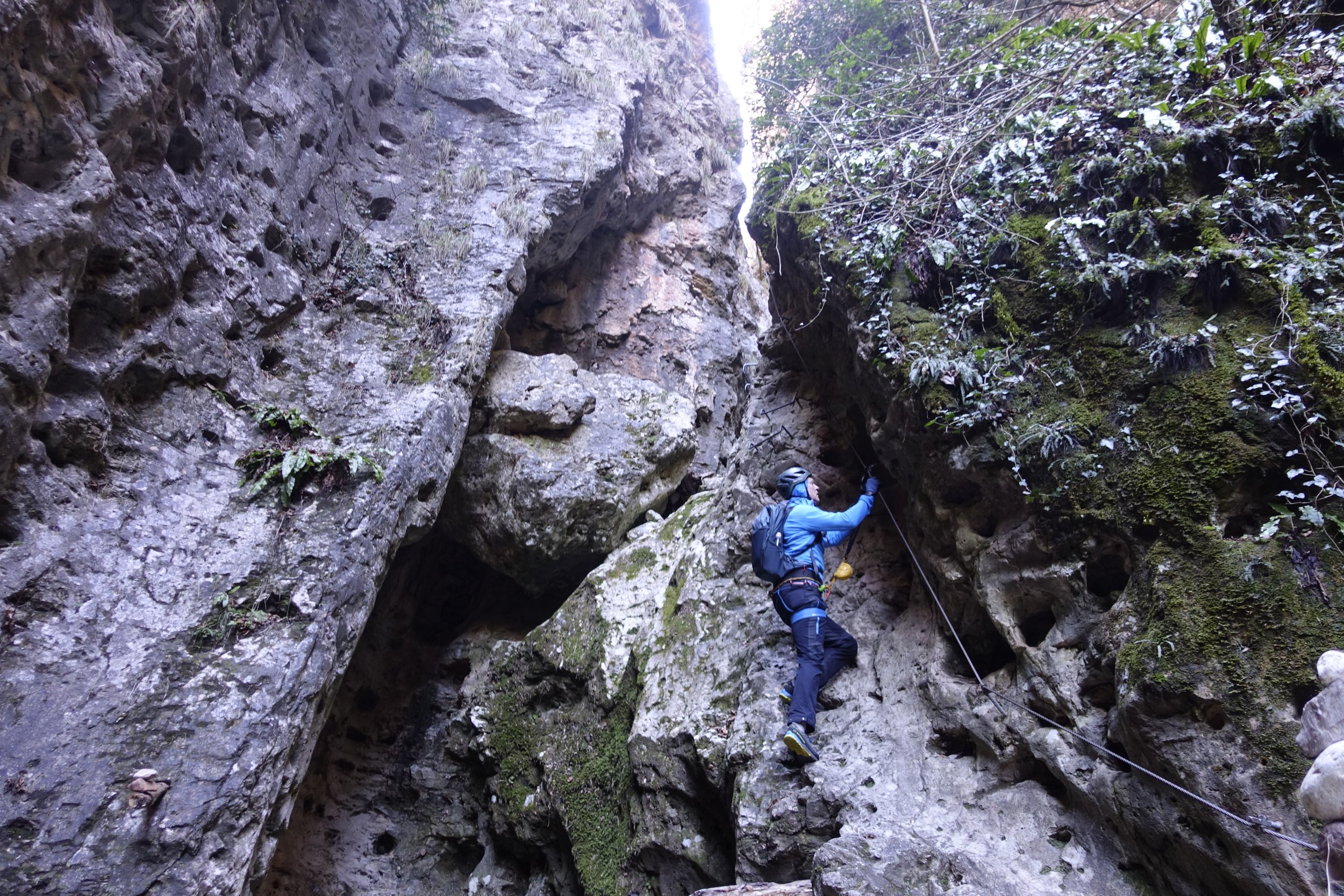
Like the Burrone Giovanelli, this ferrata also follows a narrow canyon with steep rock walls rising around you, creating a surprisingly wild environment.
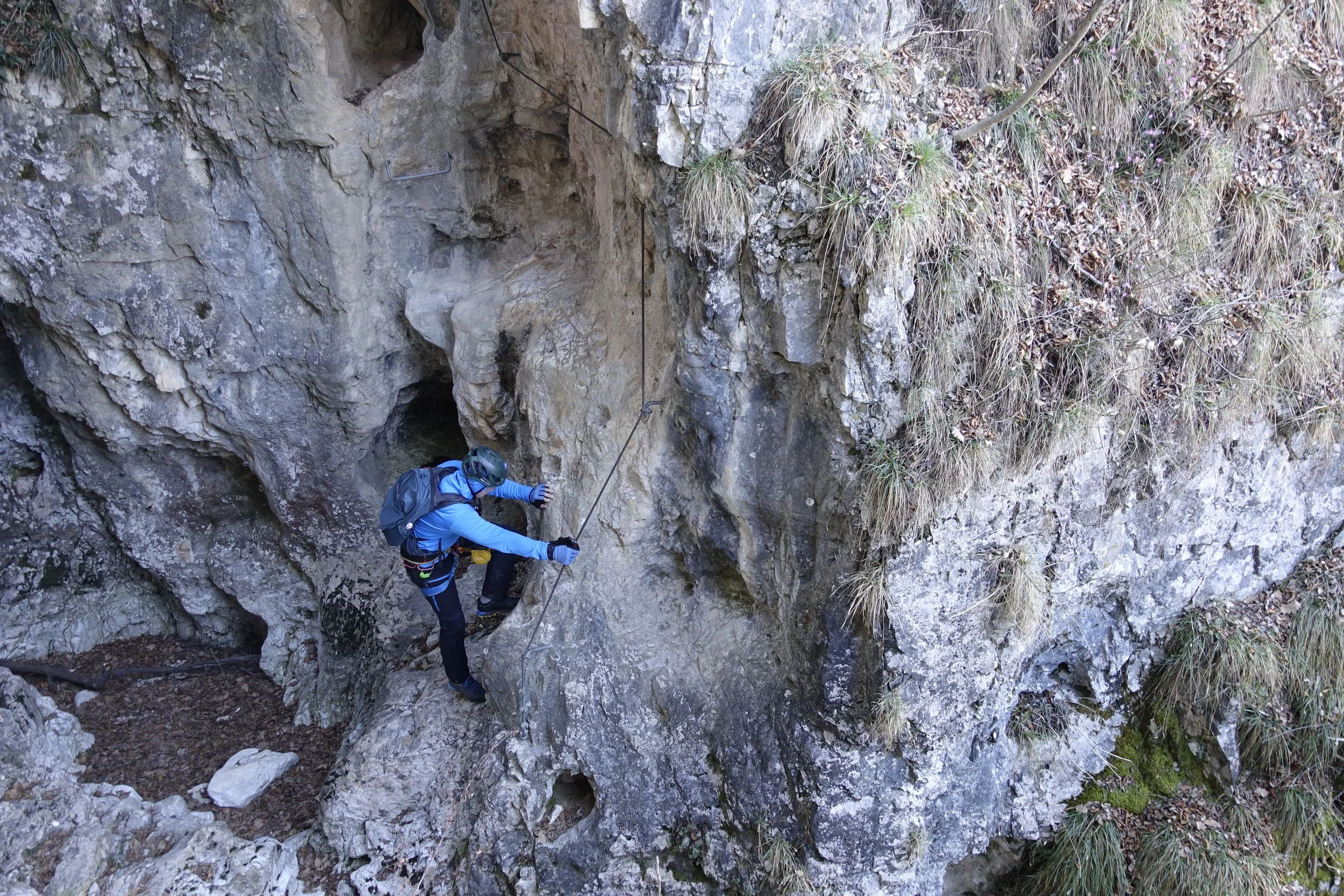
During the climb my new friend began experimenting with smearing, placing his feet directly on the rock instead of relying only on the metal rungs. It was a small but important step, helping him feel more comfortable using the natural features of the rock… a skill that would become veeeery useful the following day.
I could also clearly see that he had good strength in his arms and solid fitness. Before coming to the Dolomites, he had prepared specifically for this adventure by training with long hikes carrying a heavy backpack and spending time in a climbing gym, using the auto-belay systems to build endurance in his arms. A perfect training for this week together!
The descent follows a rather exposed trail, where careful footwork and attention are required.
By the end of the day it was clear that he was already feeling comfortable on via ferrata terrain, and ready to raise the bar again for the next stage of the adventure!!
Day 3 – Via Ferrata Stuller Waterfall
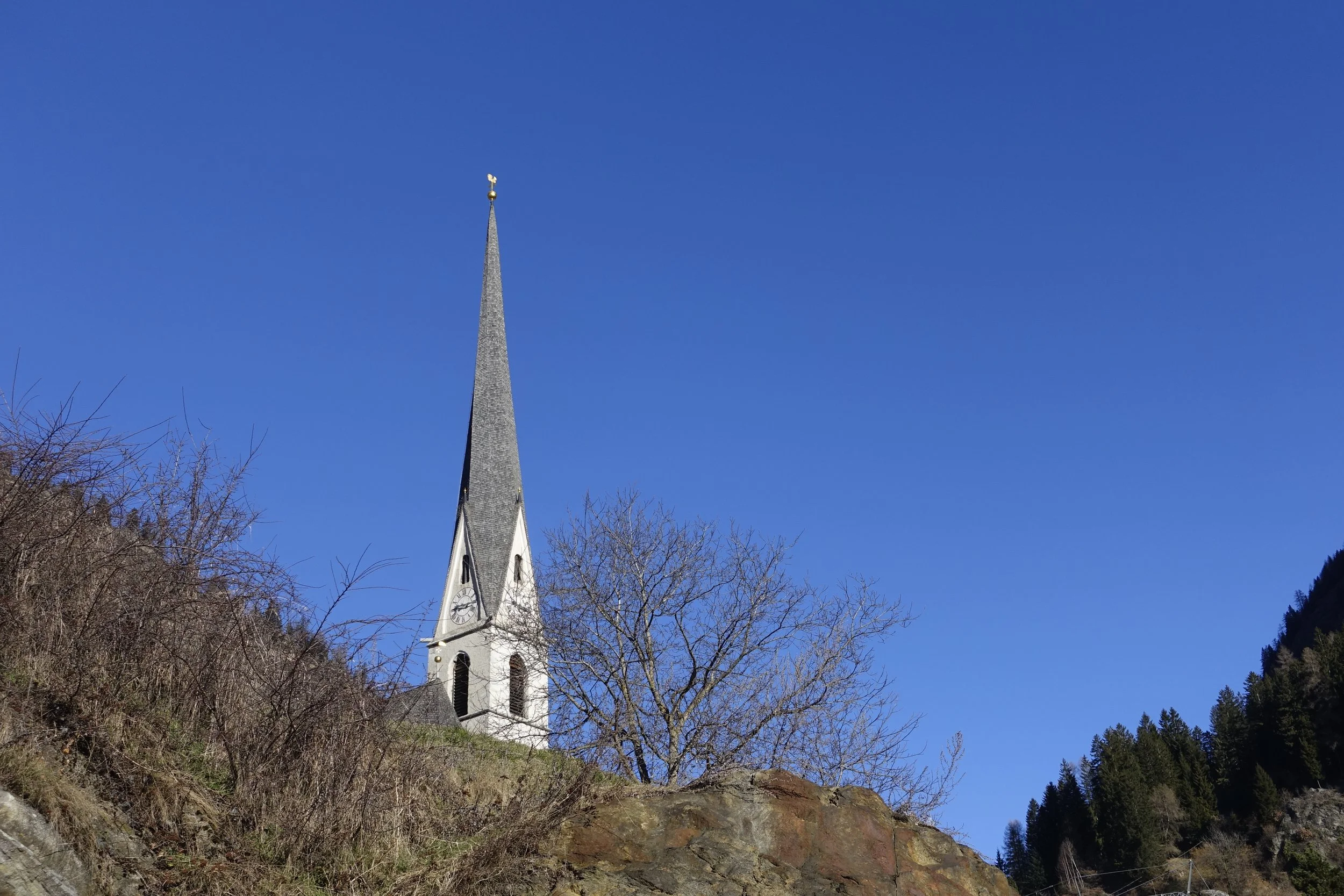
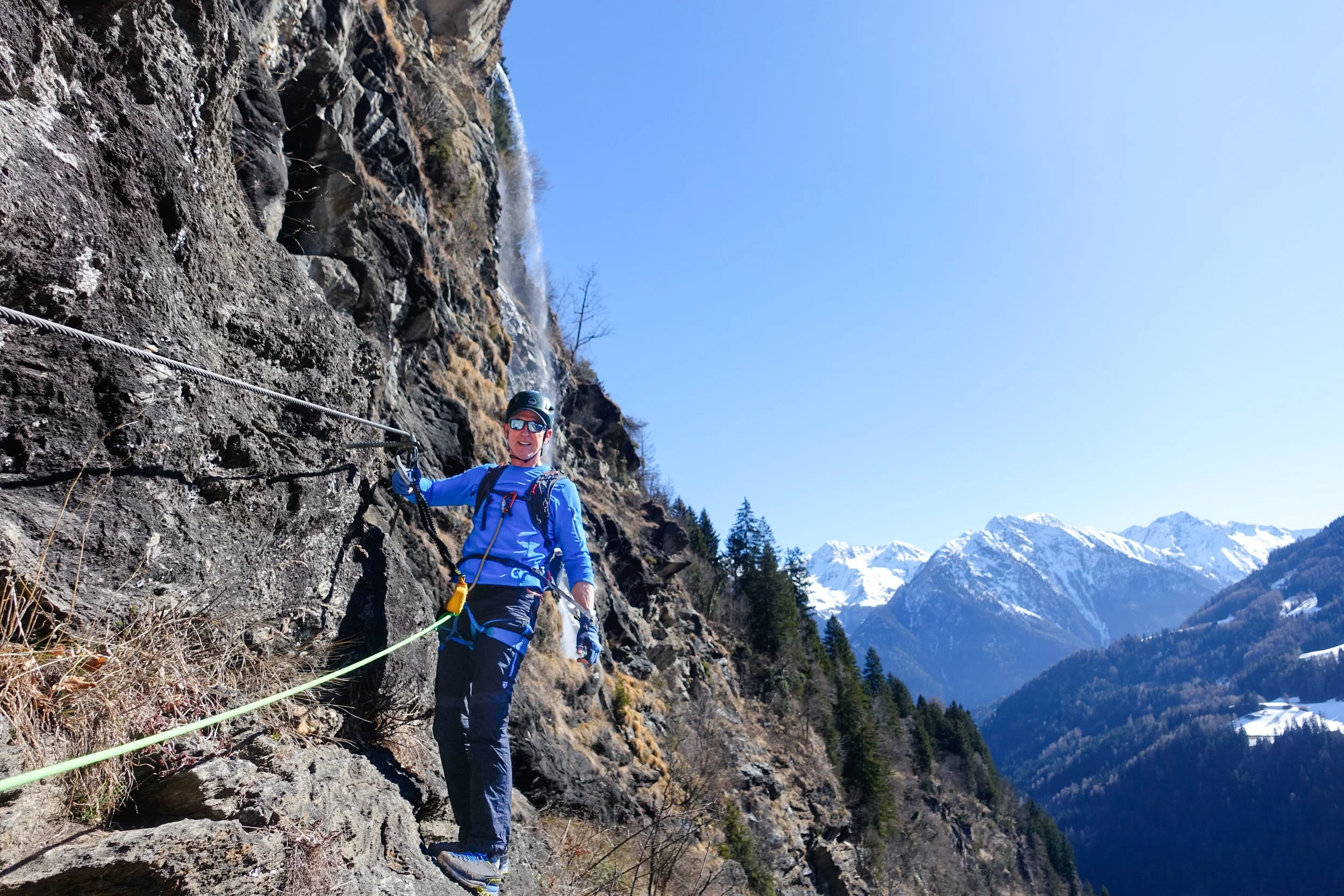
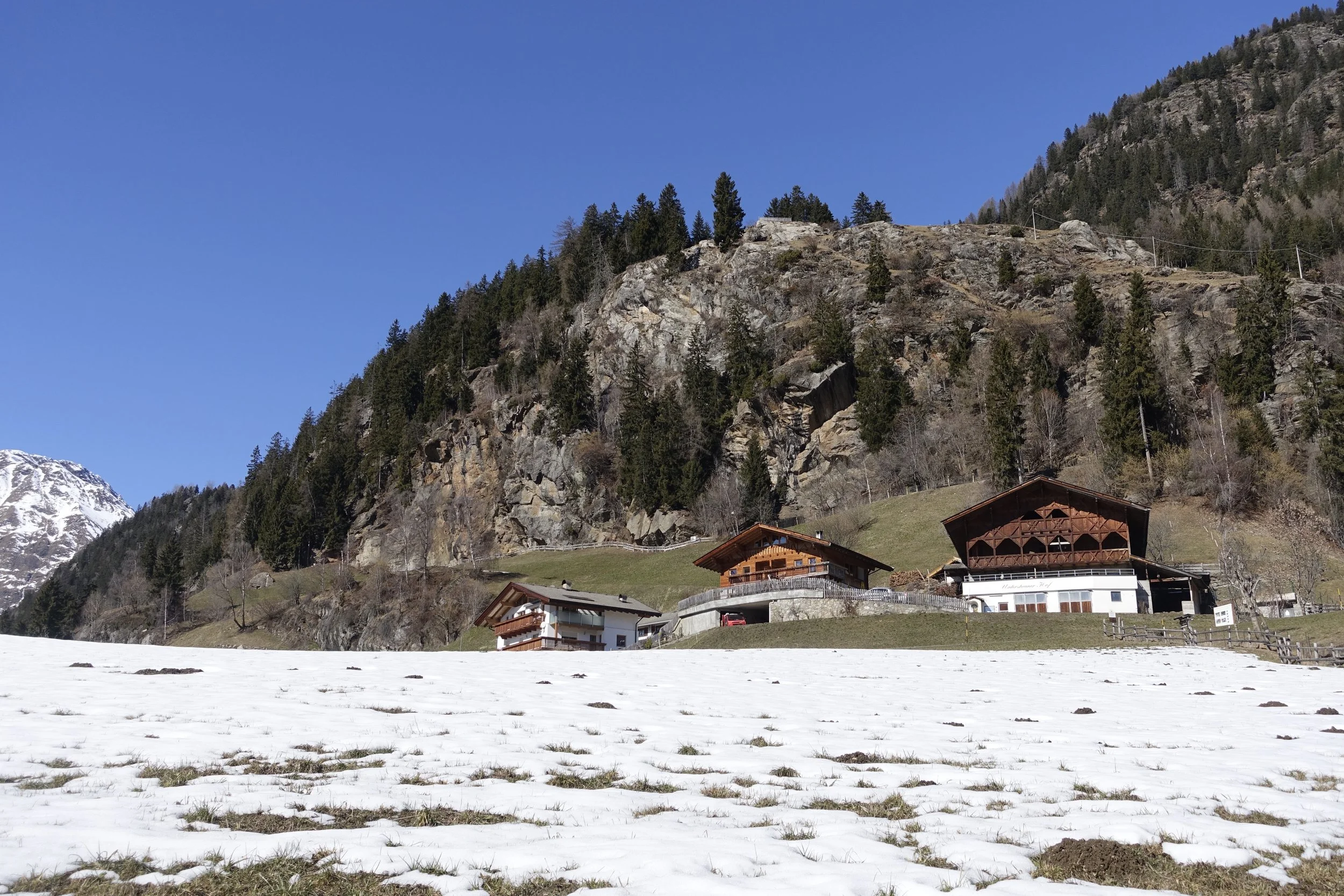
On the third day we headed to Val Passiria, a beautiful valley about an hour north of Bolzano. The ferrata we had in mind is a relatively recent one, built in 2019 near the village of Moso.
Val Passiria is a remarkable place. The valley rises from the mild, almost Mediterranean landscapes around Merano, where vineyards and orchards thrive, all the way up to the wild alpine environment of the Texel Group, with rugged peaks reaching over 3000 meters.
Historically, this valley was also an important trade route across the Passo Rombo (Timmelsjoch), today the border between Italy and Austria. It is also the birthplace of Andreas Hofer, the famous Tyrolean innkeeper and revolutionary who led the resistance against Bavarian rule in the early 1800s… but that’s another story!
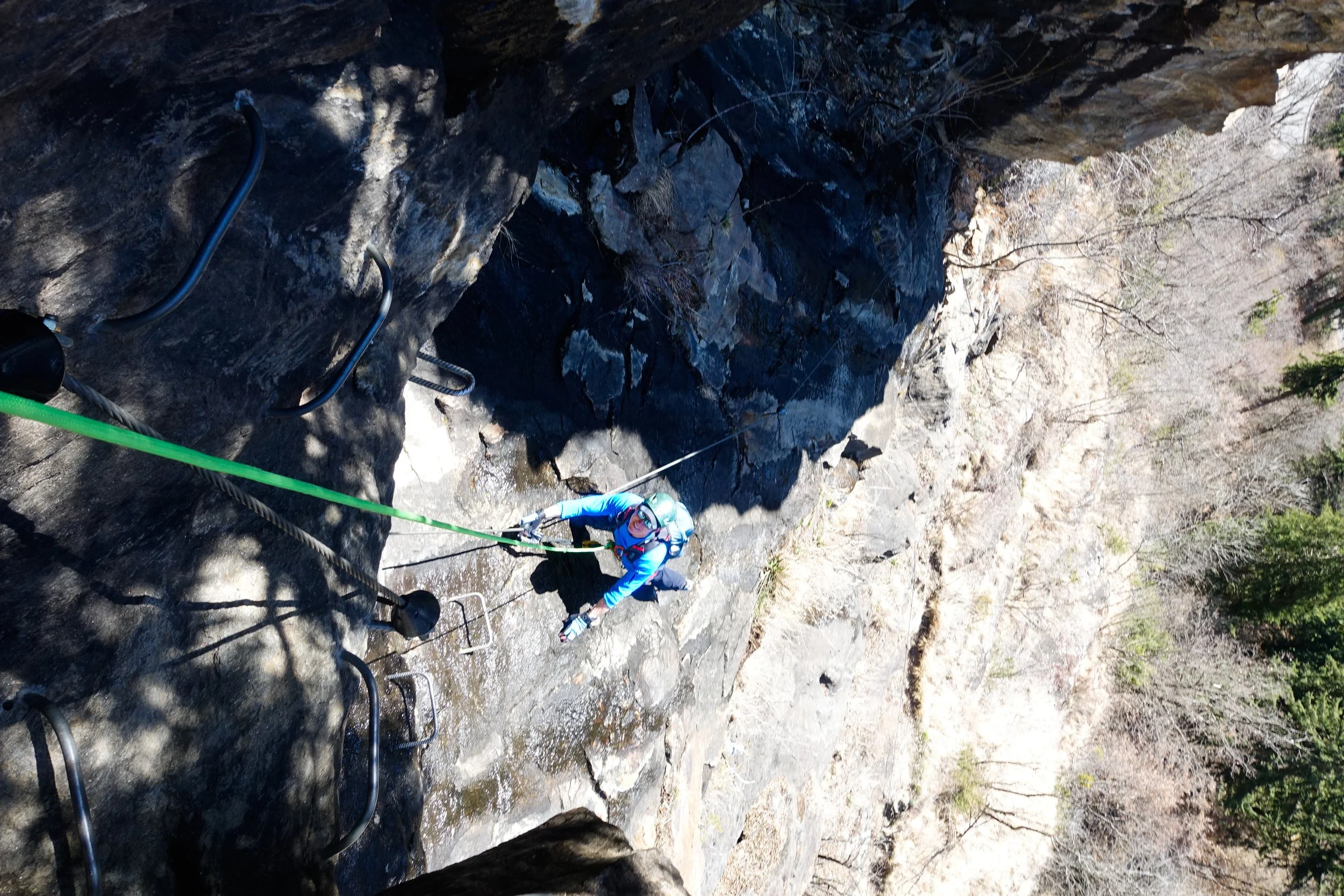
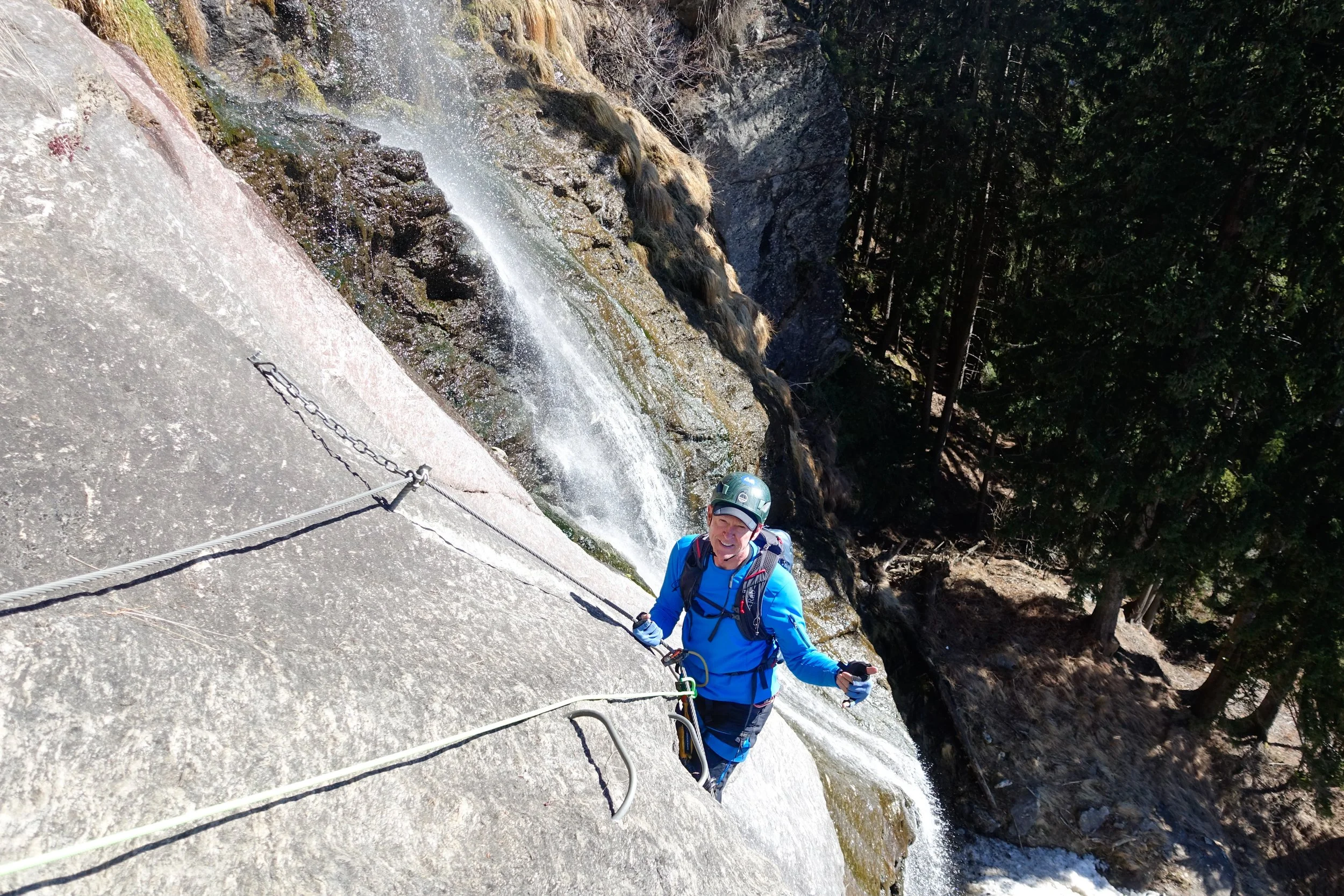
Our objective for the day was the Via Ferrata Cascata di Stuller.
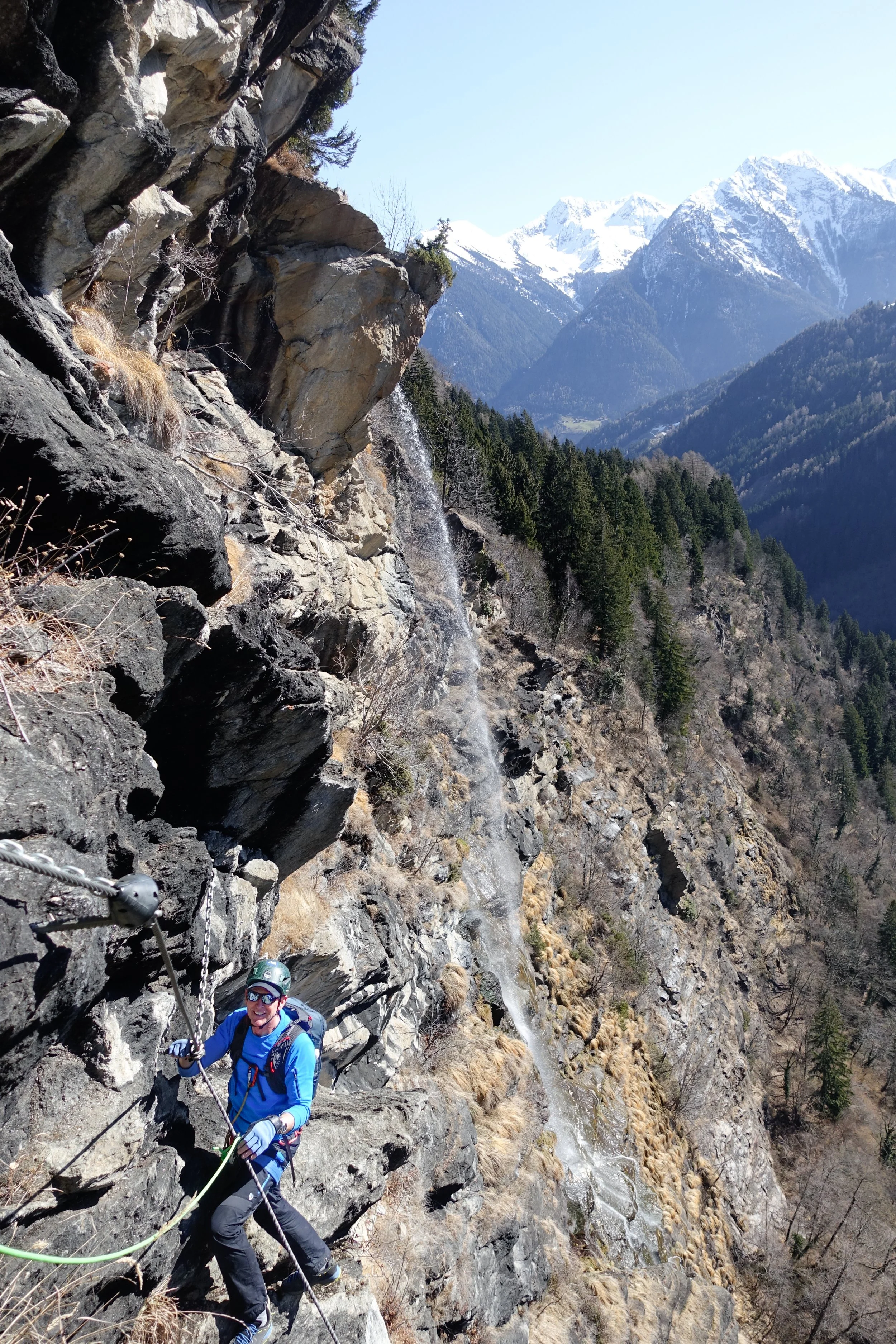
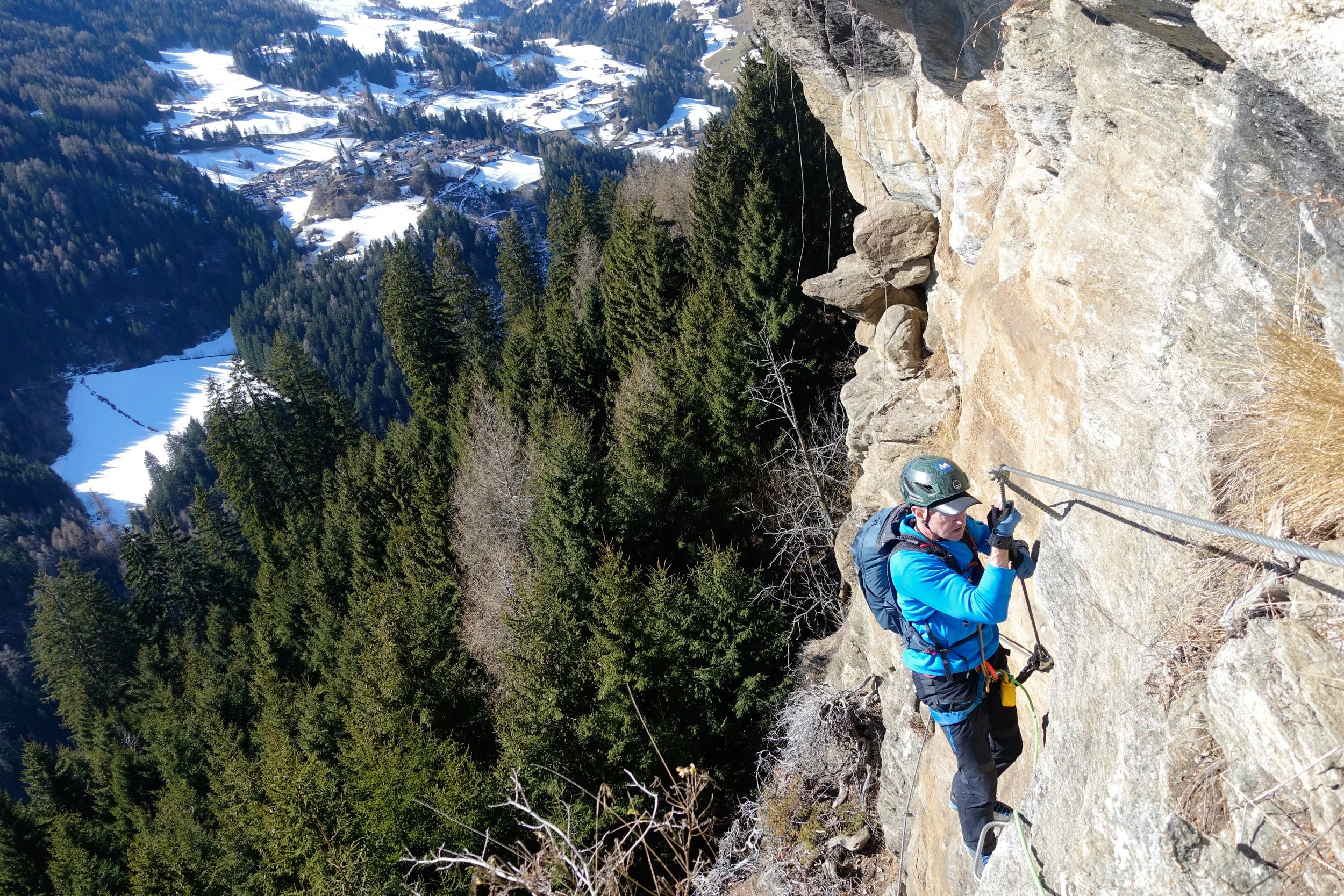
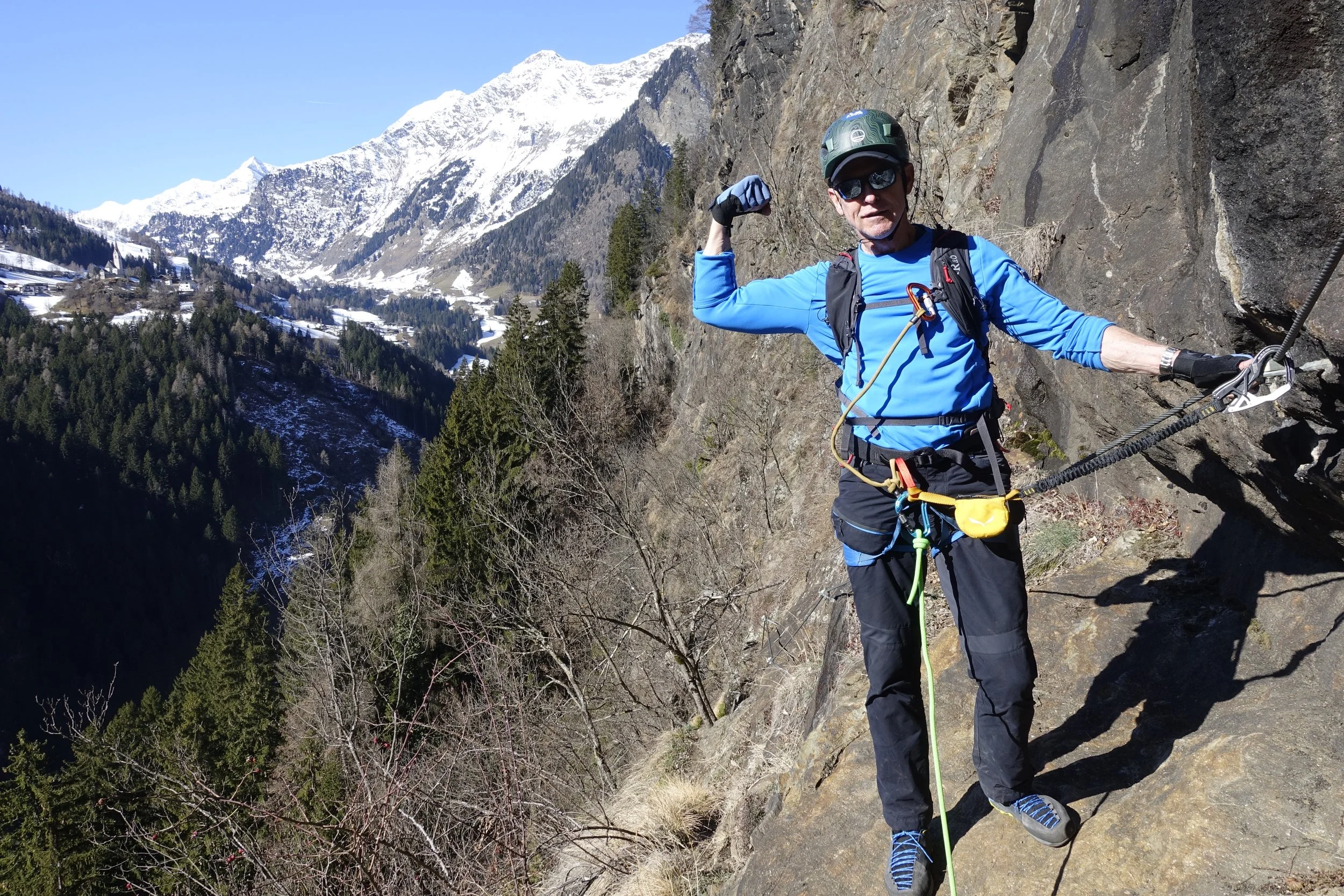
The ferrata reaches grade D in one section, although it remains consistently around C, requiring good arm endurance and confident footwork on the rough gneiss rock. For those looking for an extra challenge, the route even offers a few harder variants with overhanging sections.
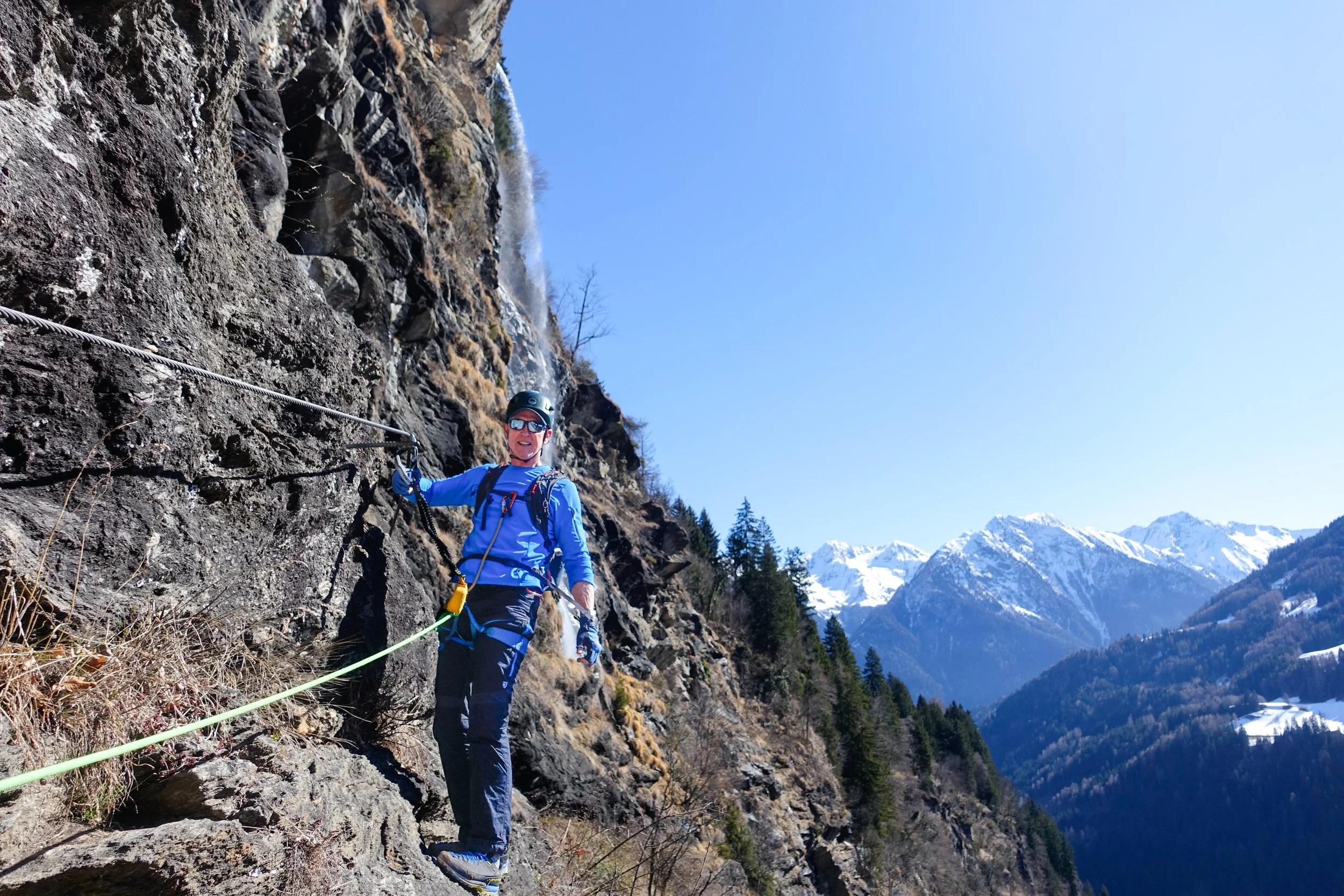
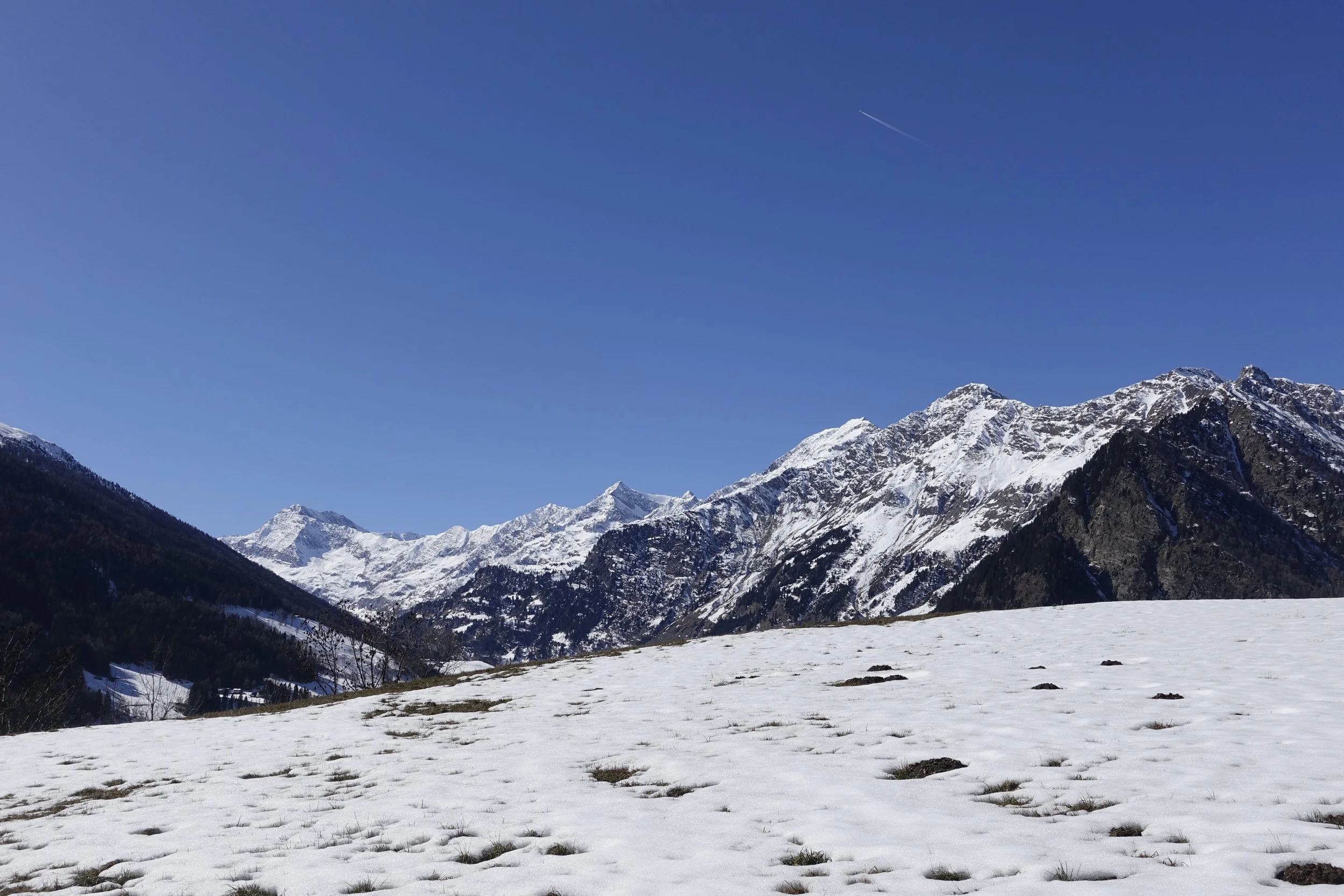
We climbed the ferrata in the sun, as it sits on the south-facing side of the valley. On the opposite slopes we could see ski touring tracks still crossing the snowy mountainsides, while higher up the peaks were freshly dusted with new snow, creating a beautiful contrast between winter and spring.
The highlight of the climb is the Stuller waterfall, which flows just a few meters beside the ferrata. Throughout the ascent the sound of the water accompanies you, giving a powerful sense of nature’s energy as the cascade plunges down the rock.
At the top of the route the terrain suddenly changes. After the vertical walls of the ferrata, you arrive on the green alpine meadows around the farms of Stuls, a peaceful and traditional corner of the valley.
Unfortunately we missed the bus by just a few seconds.
Luckily a friendly local farmer gave us a lift back down to Moso. As he told us during the short drive:
"Life is hard for farmers here in Val Passiria at 1300 meters… but the beauty of this place is endless."
After spending the day in these mountains, we could only agree!
Day 4 – Via Ferrata Marangoni
For the fourth day we had planned another step forward in difficulty. The original plan was to climb the Via Ferrata Hoachwool above Naturno, a long and demanding route that would have been a perfect progression for the week.
But during the night the weather changed unexpectedly. Rain, and even some snowfall higher up, forced us to rethink the plan.
No problem. One of the advantages of being based in Bolzano is that you can always move to a different valley where the weather is better. So we decided to head south, where the climate is often milder.
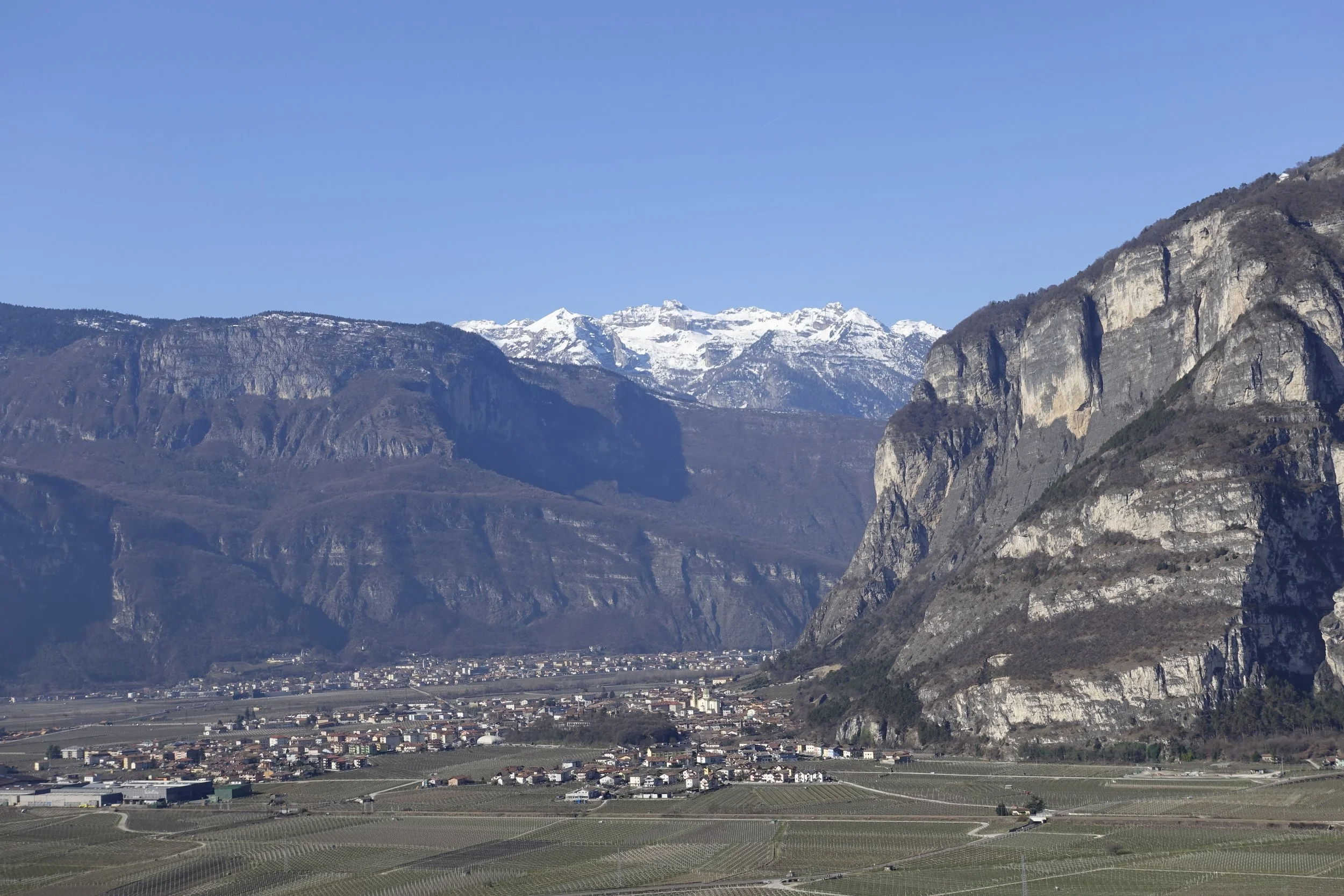
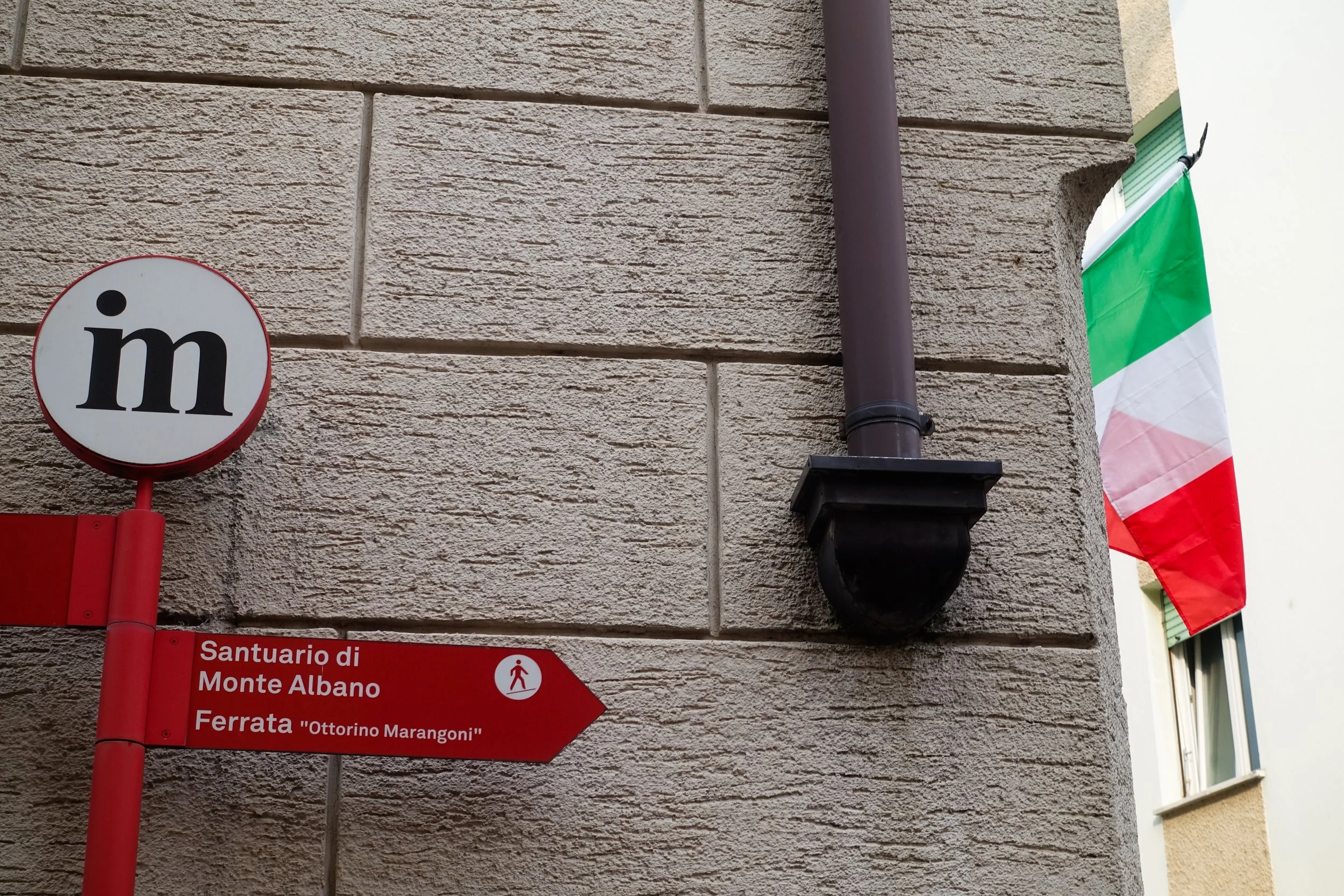
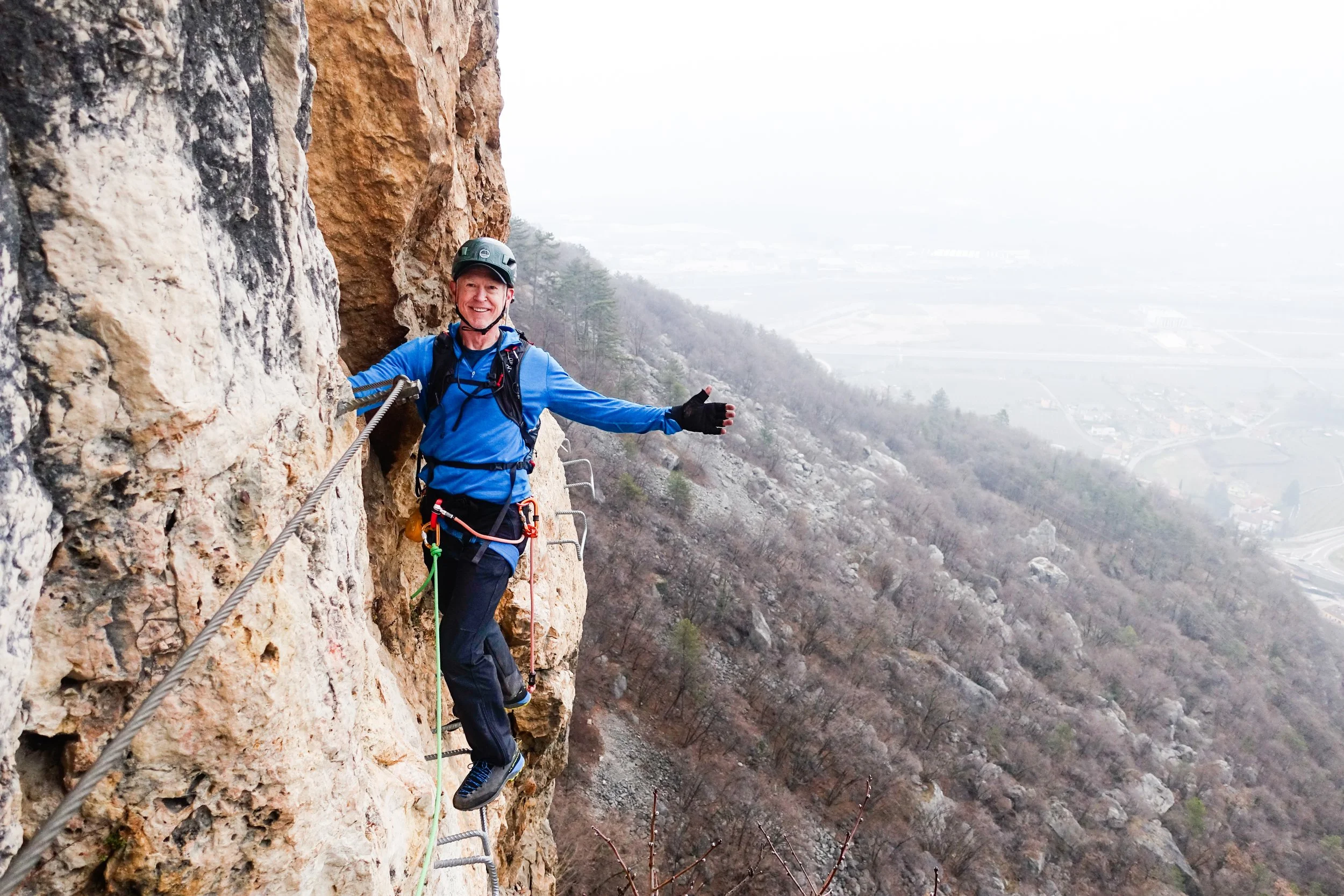
Our new objective became the Via Ferrata Marangoni on Monte Albano, starting from the village of Mori, located between Rovereto and Lake Garda.
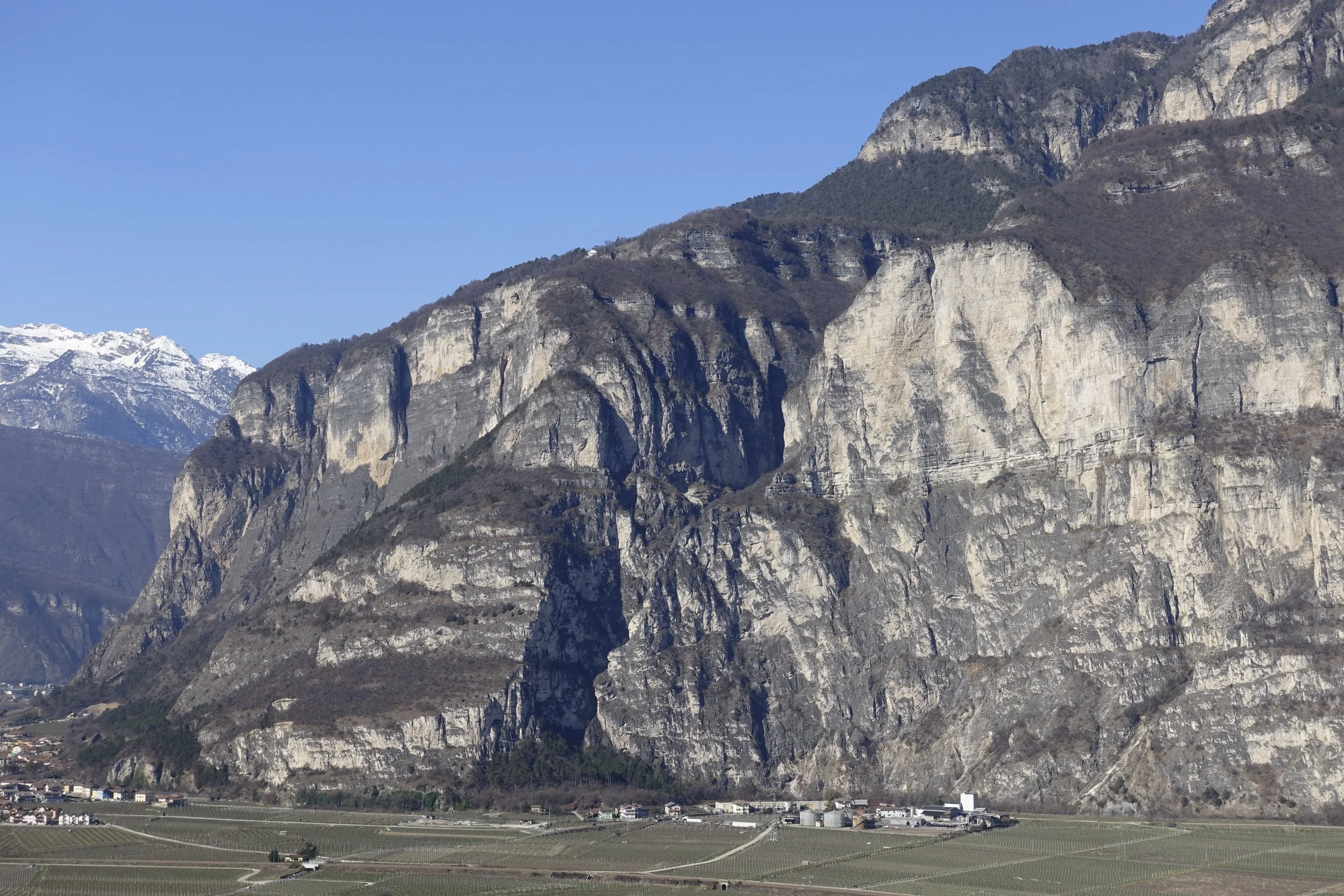
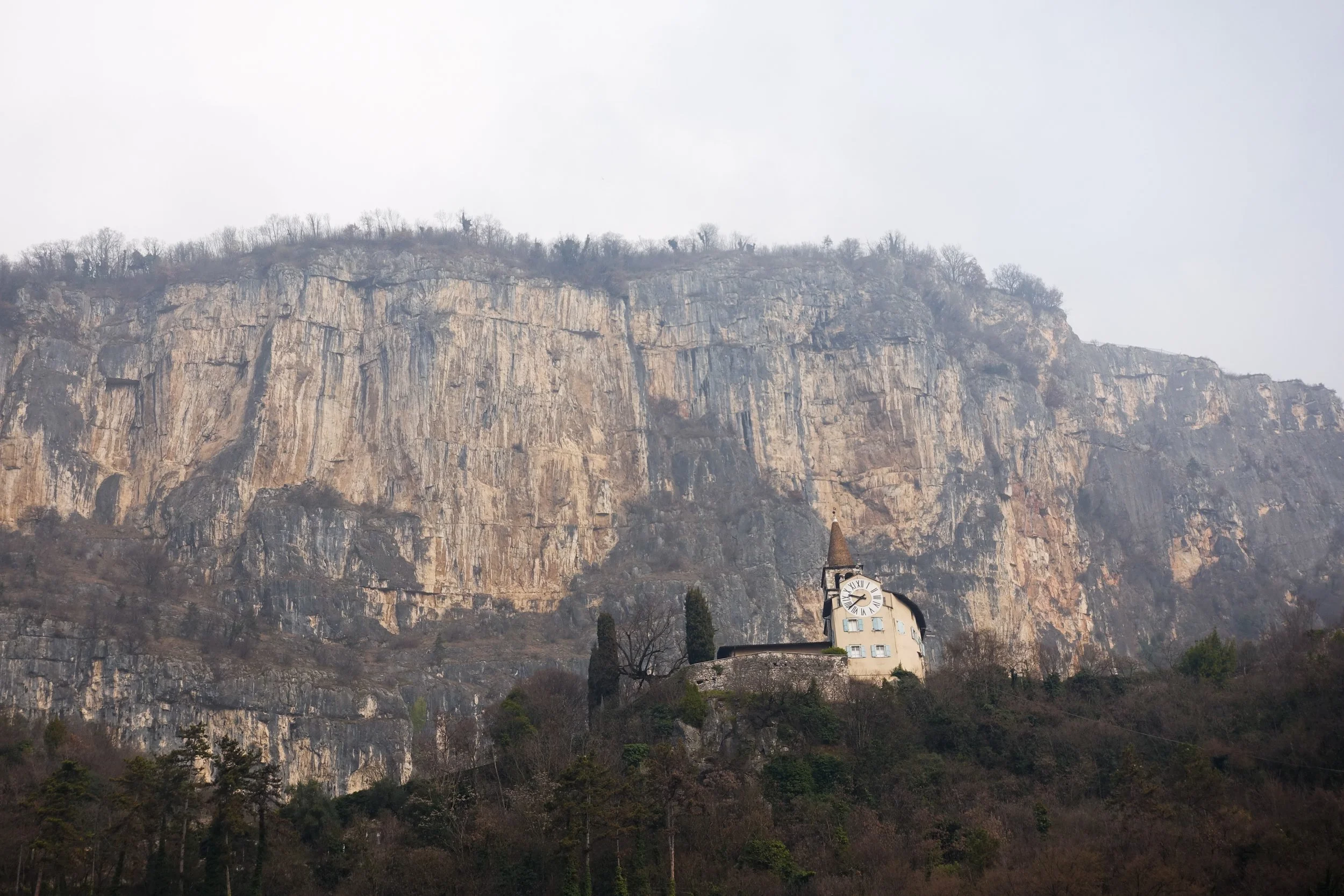
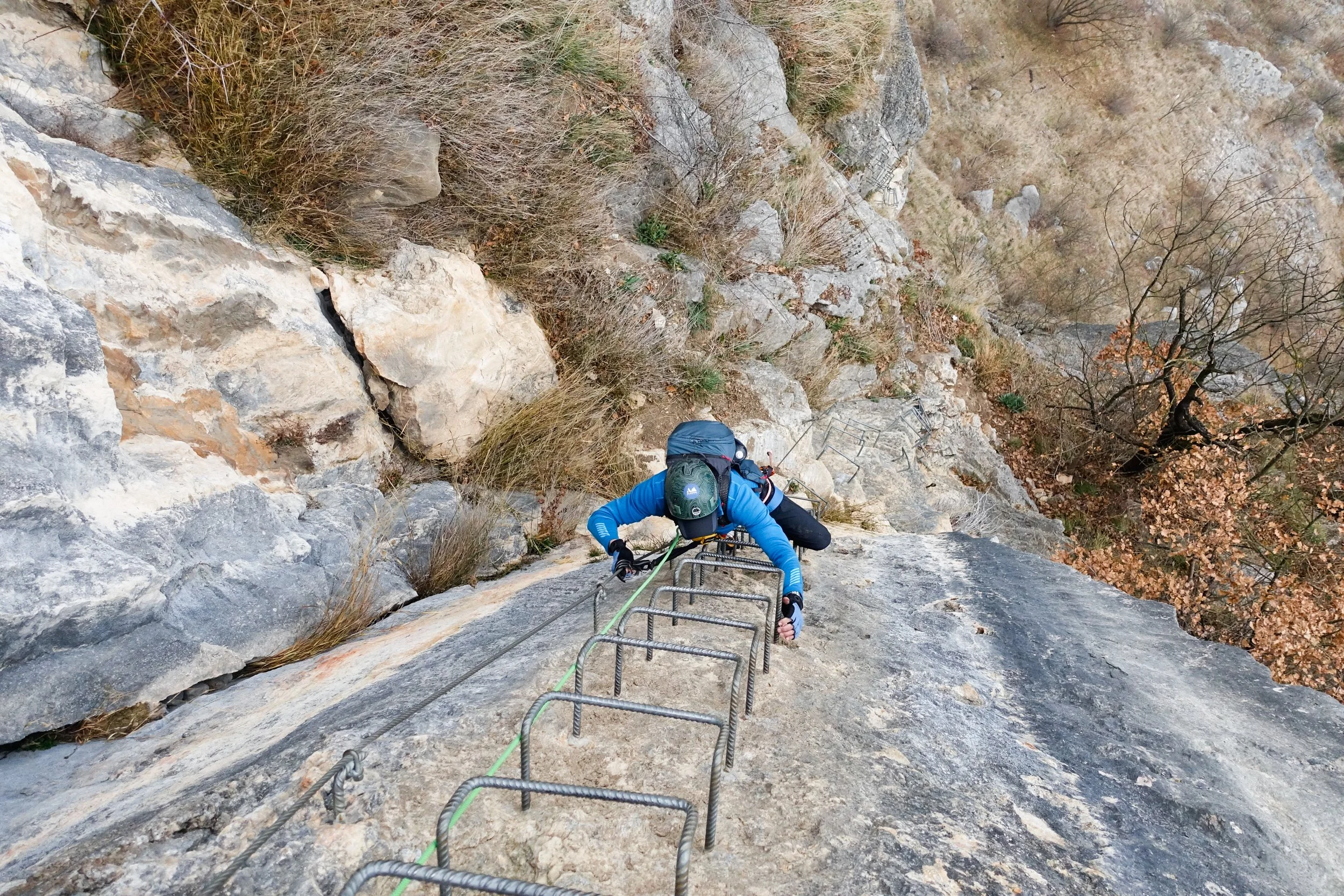
As soon as we stepped out of the car and looked up at the wall above us, it was immediately clear where the ferrata was going… and it looked impressively steep! :D
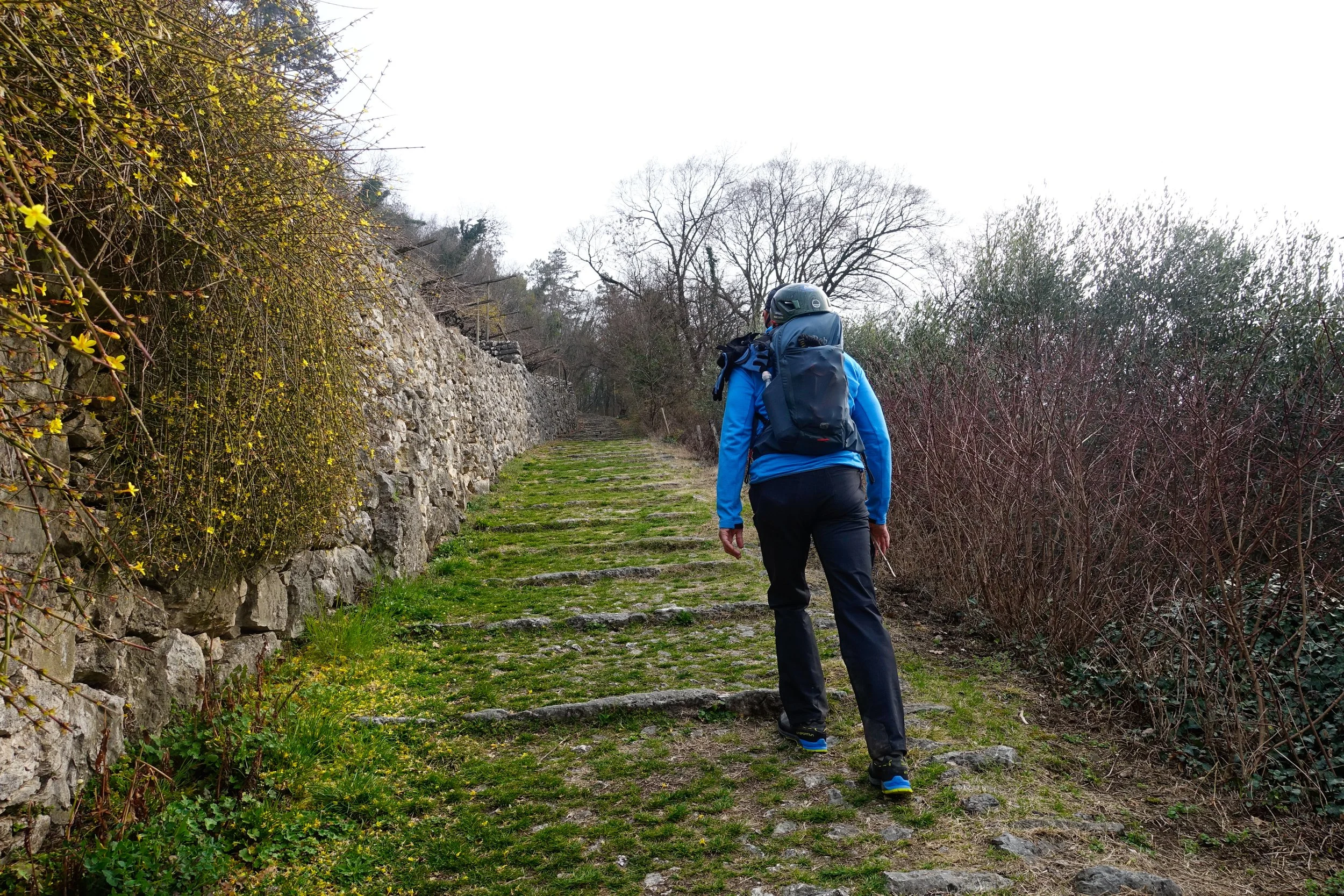
At the base of the wall lies a pleasant climbing area with several bouldering blocks and an old sanctuary that rises above the village. From there we followed a series of ancient cobblestone steps up to the trail leading to the ferrata, where we stopped to put on our equipment.
The Via Ferrata Marangoni, built in the 1970s, was considered one of the most extreme ferratas of its time. It was also somewhat revolutionary. While the earliest ferratas were built mainly to help climbers reach mountain summits, this route was among the first designed to overcome a short but very vertical wall purely for the sporting challenge. In many ways it reflects the same evolution that was happening in mountaineering at the time.
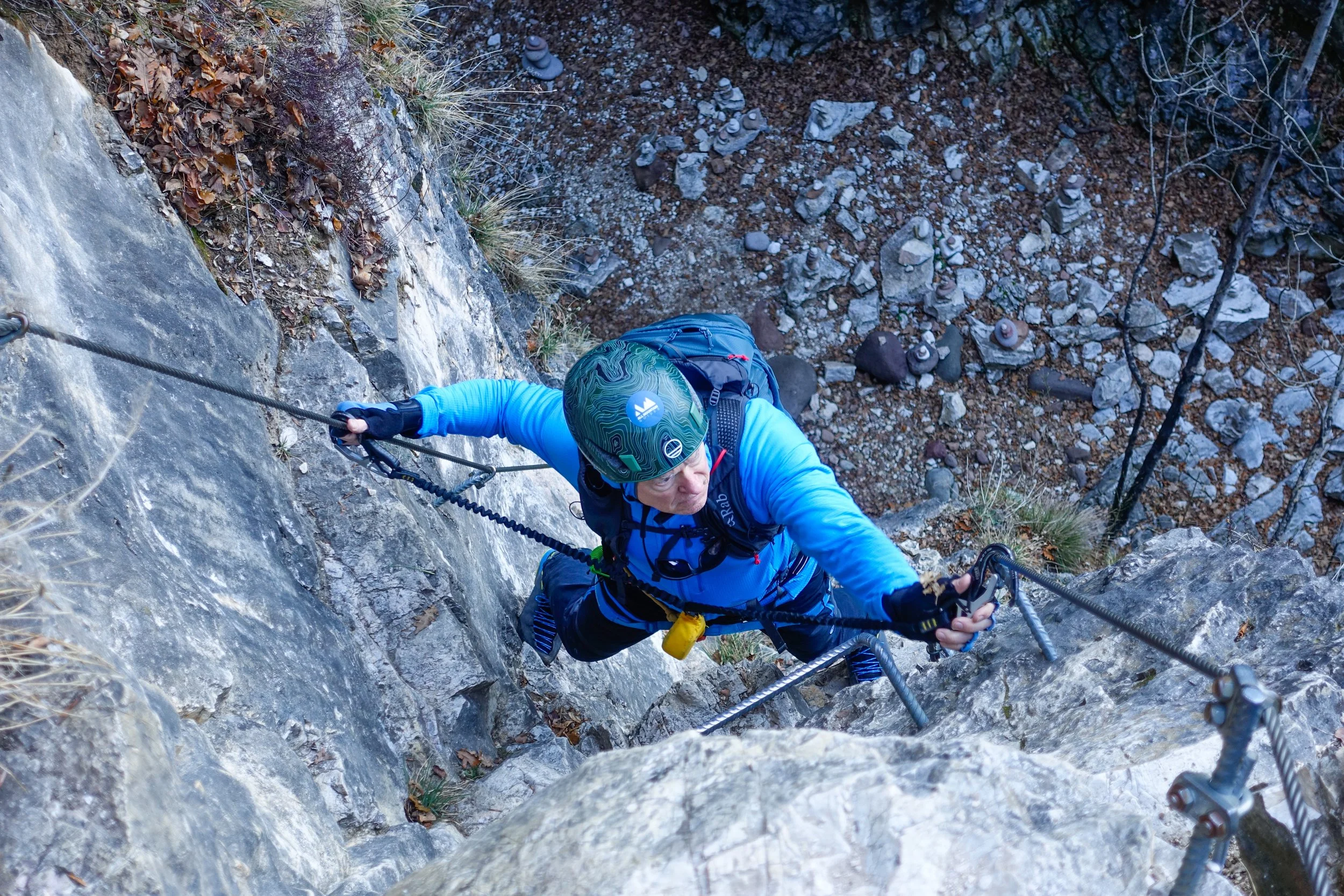
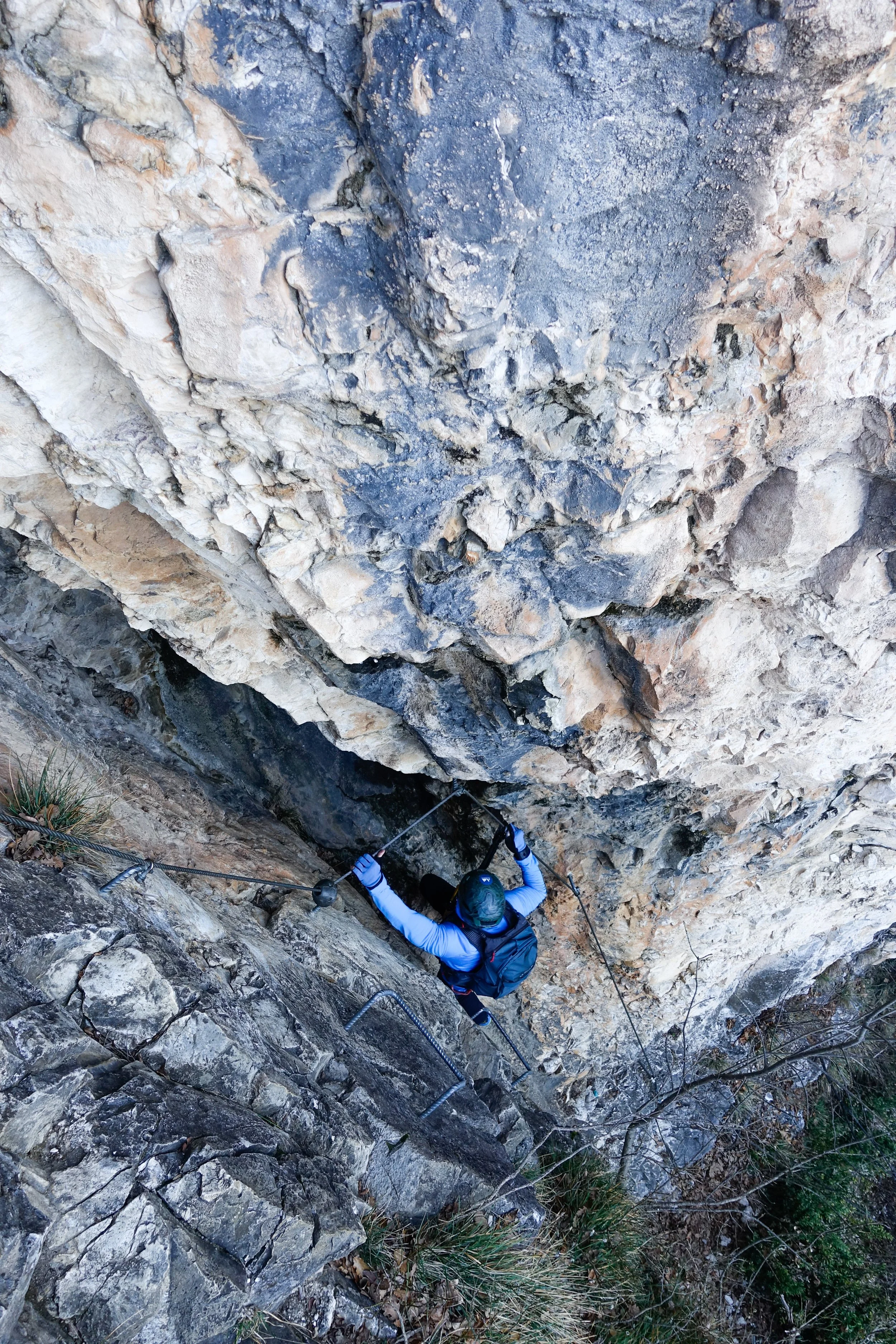
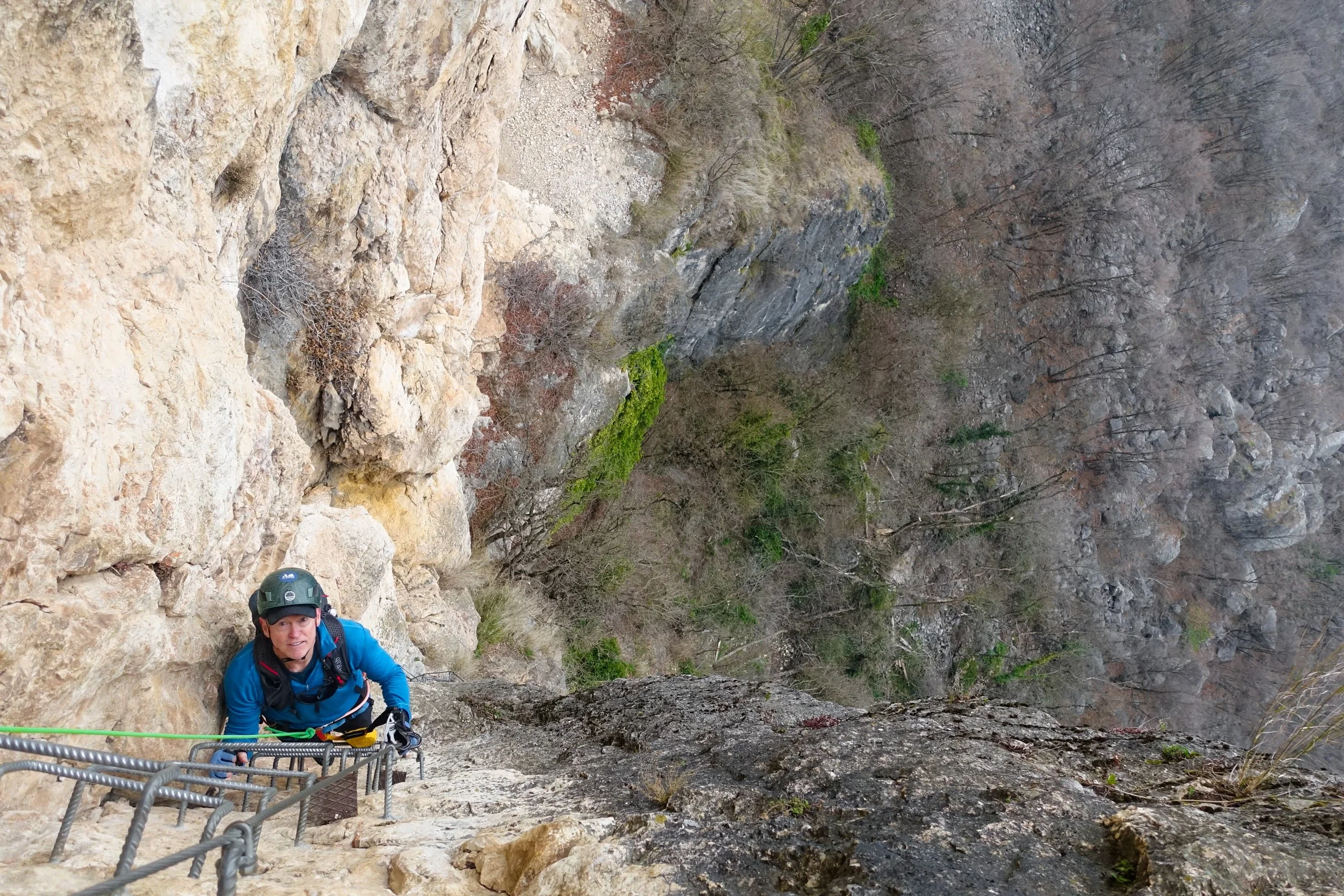
The ferrata reaches a maximum difficulty of around C/D, mainly because of the sustained physical effort required on several vertical ladders. But the real challenge lies in the exposure and in the need to trust your feet on the rock.
Two famous traverses, the “Owl Traverse” and the “Angels Traverse”, require careful foot smearing and confidence while moving across the steep face.
At the top of the route we found a perfect spot to rest: a small bench overlooking the valley, where we enjoyed a well-earned sandwich! Another great day in the mountains.
Day 5 – Via Ferrata Hoachwool
The day had finally arrived.
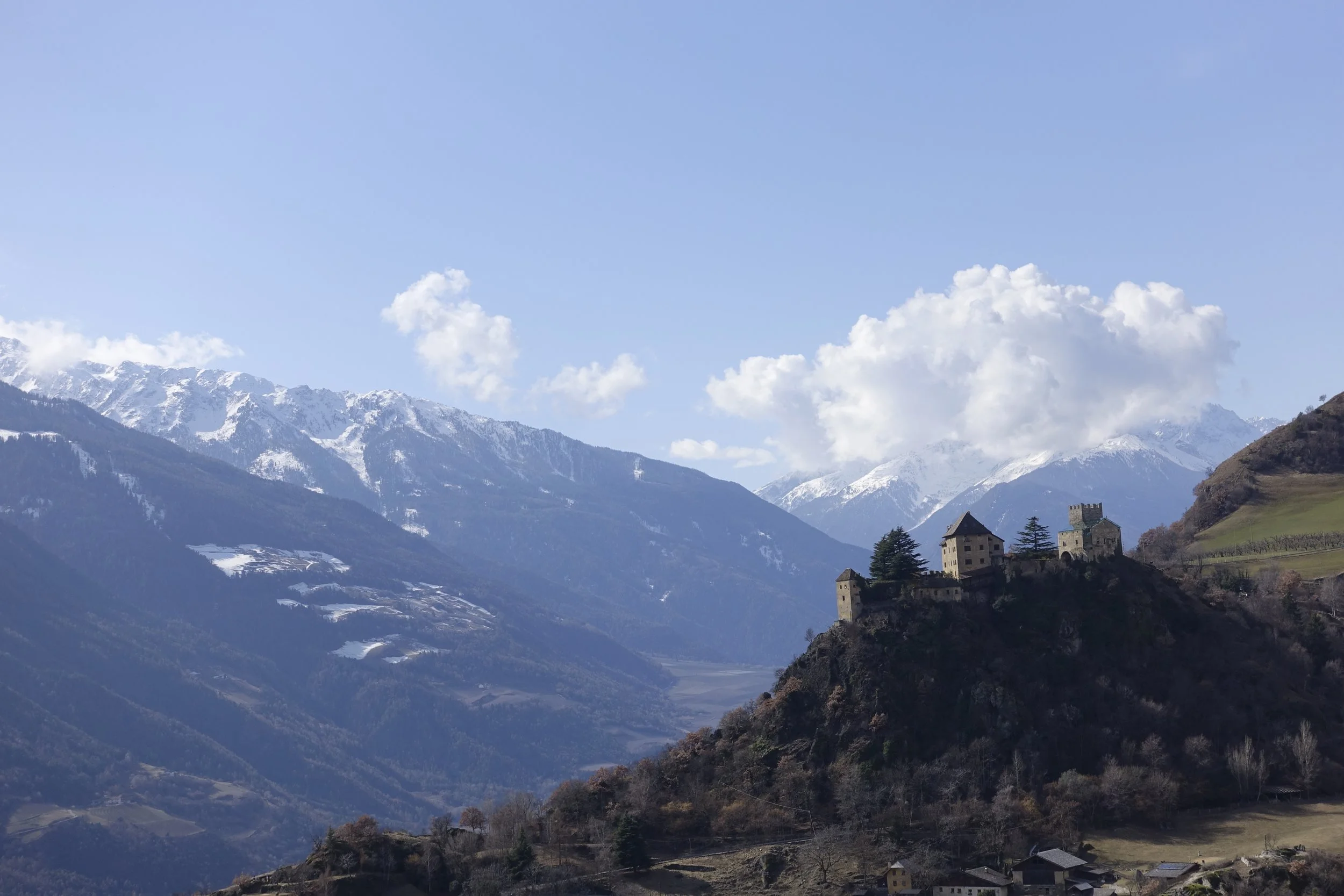
After spending several days climbing together and watching my new friend grow more confident and technically solid on each route, I felt it was time to take him to one of the most demanding via ferrata in South Tyrol: the Via Ferrata Hoachwool, located above the village of Naturno in Val Venosta, often called the valley of apples.
The ferrata climbs the south-western slopes at the entrance of Val Senales, the valley whose glaciers famously preserved Ötzi the Iceman, discovered in 1991 and now displayed in the museum in Bolzano.
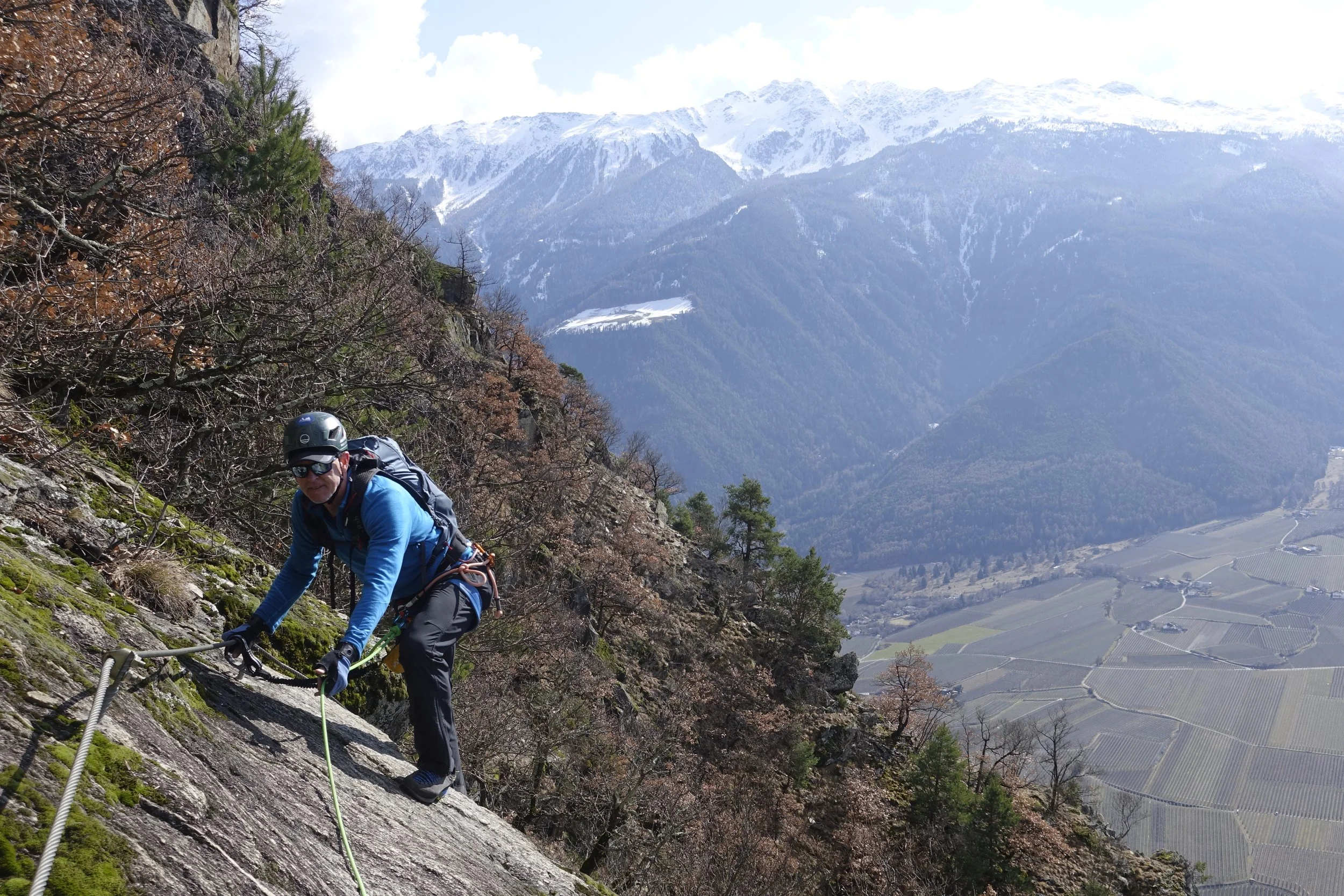
From a technical perspective, Hoachwool is a serious route. The ferrata is graded D (with harder variants) and is also very long, gaining around 600 meters of vertical elevation (about 2,000 ft) along the wall, with numerous traverses and sustained sections that require endurance and focus.
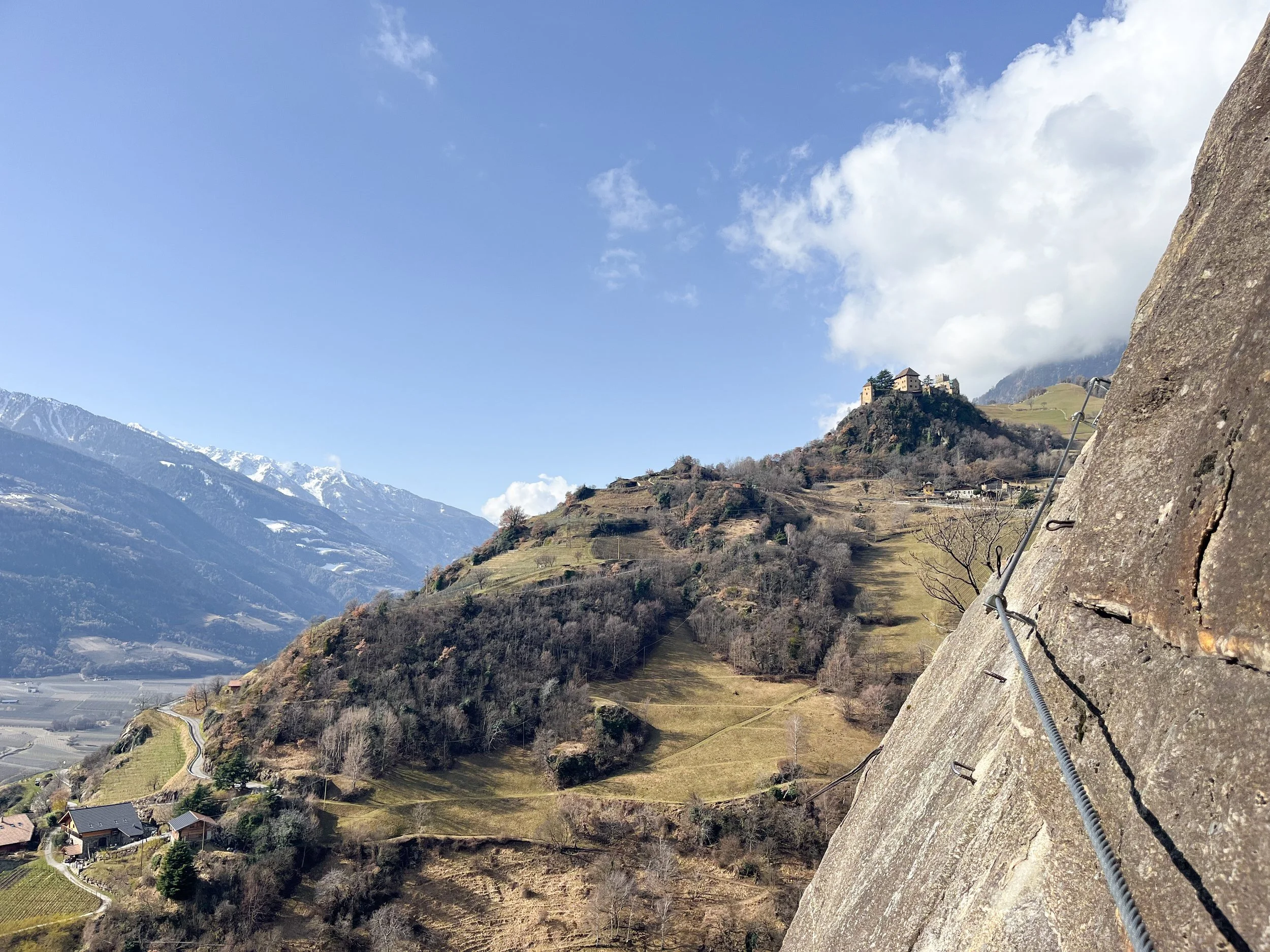
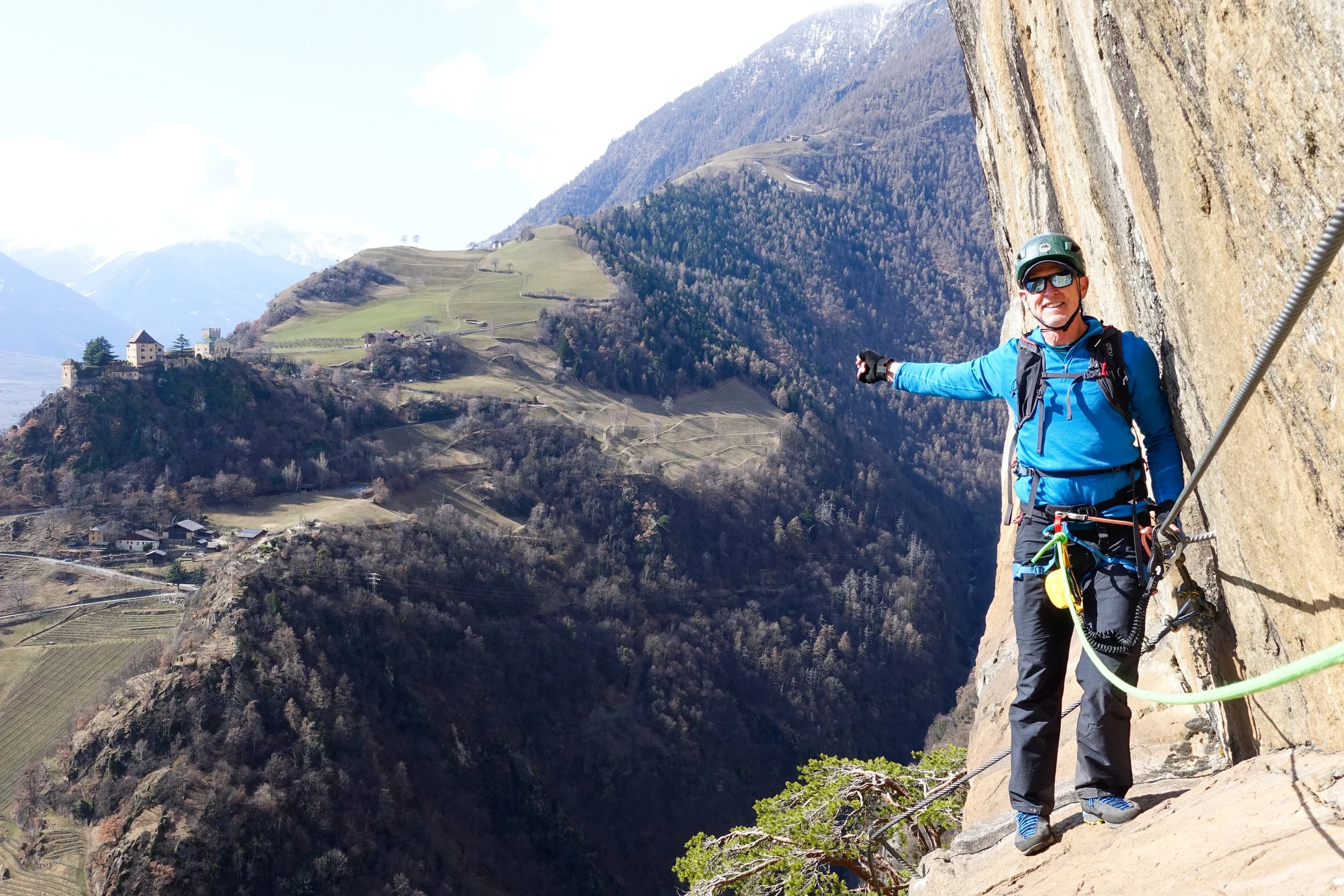
Roughly halfway up the route you reach a small saddle known as Sattele, where a bench offers a perfect place to rest and admire the view across the valley towards Castel Juval. The castle is the residence of the famous mountaineer Reinhold Messner, the first person to climb all fourteen 8000-meter peaks in the world, and today it hosts one of the museums of his Messner Mountain Museum, dedicated to the “myth of the mountain”.
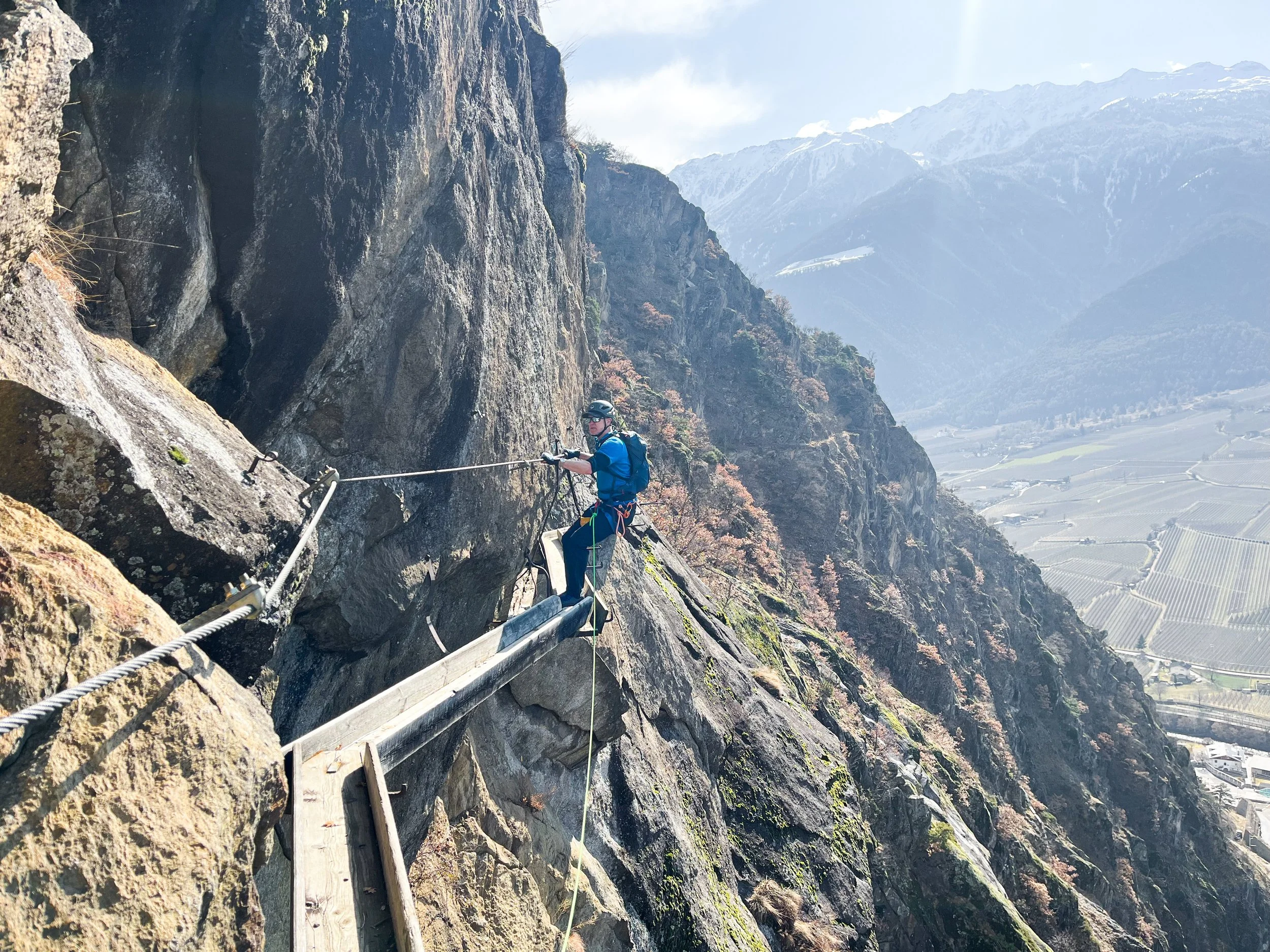
The ferrata itself follows part of the historic path of an ancient irrigation system, once used to bring water from Val Senales down to Naturno. This canal, about 10 km long, was known locally in dialect as the “Hoachwool,” meaning the “high channel.” It once started near Rattisio Vecchio in Val Senales, around 850 meters above sea level, and carried water across the dry slopes of the Monte Sole to the farms of Naturno.
Maintaining this canal was extremely dangerous work. In 1910 the most exposed section was finally closed, but today the via ferrata allows visitors to experience part of this incredible engineering feat. Along the route you even walk on reconstructed wooden larch channels, just like those once used by the canal workers.
At the top of the ferrata it is possible to descend on foot, but after such a long climb we decided to walk another 15 minutes to reach the cable car instead.
Unfortunately the nearby mountain hut was closed that day… no well-earned lunch on the top for us this time!
But on the way back we made a stop at the historic Forst Brewery, where a cold beer was the perfect way to celebrate one of the most memorable climbs of the week!
Day 6 – Via Ferrata Val del Rì
For the final day together I chose a recently built via ferrata inside the impressive canyon of the Val del Rì, carved by the waters of the Rio Fai.
The route begins in an unusual place, the cemetery of Mezzocorona (not exactly the happiest starting point for a climbing day!). But that detail is quickly forgotten once the adventure begins.
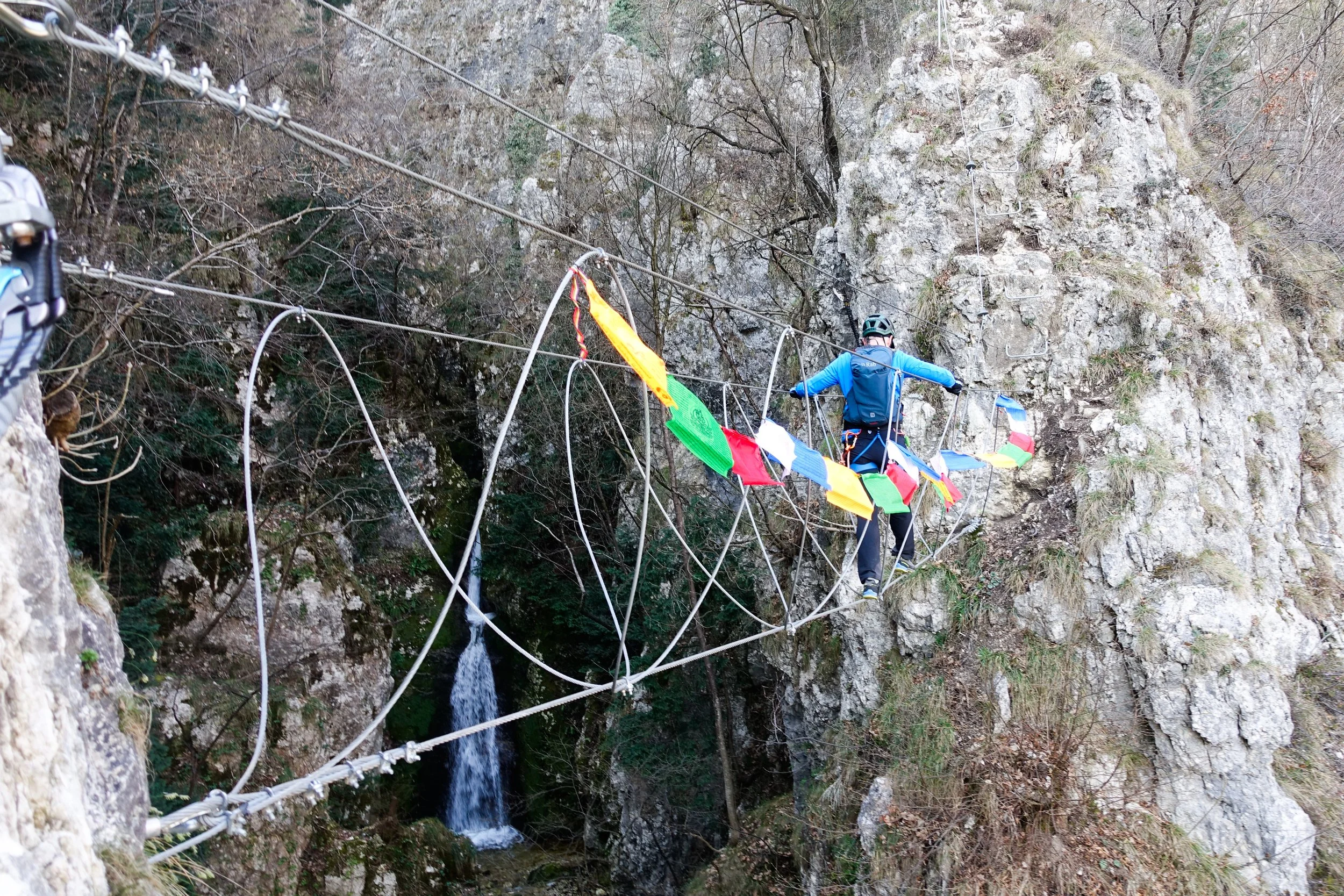
Just a few minutes from the start we crossed one of the longest suspension bridges in Italy, an exciting introduction before entering the narrow canyon itself.
The ferrata begins immediately with a series of metal rungs that quickly warm up the arms. From there the route continues through the gorge, alternating between vertical sections and spectacular crossings of Tibetan bridges that span the canyon from one side of the river to the other.
The ferrata reaches a maximum difficulty of grade C, but what really makes it special is the wild environment of the canyon and the constant presence of the river and its waterfalls flowing below.
After reaching the end of the ferrata, a relaxed hiking trail leads back down to the valley, providing a peaceful finish to the day.
It was the perfect way to end our week together exploring the via ferrata of South Tyrol and Trentino.
See you next time, my friend! I know you are going to come back for the summer season!
Inspired by This Adventure?
If the idea of spending several days exploring different via ferrata routes sounds appealing, you can join one of our dedicated via ferrata safari programs.
Our Bolzano Hotel-Based Winter Via Ferrata Safari is designed specifically for the shoulder seasons and winter, using Bolzano or Appiano on the Wine Road as a base camp to explore the incredible variety of ferrata routes across South Tyrol, Val Venosta, Val Passiria and the surrounding mountains, all within a short drive.
For those who would like to combine spectacular ferrata with a more Mediterranean atmosphere, the Lake Garda Via Ferrata Safari is based around Riva del Garda and Arco. Here dramatic ferrata routes rise above the lake, and the adventure can easily be mixed with the relaxed lifestyle of Garda… and perhaps even a bit of rock climbing in Arco, one of the most famous climbing areas in Europe!
